


The American workforce faces unprecedented changes, as 46.6 million workers resigned in 2022 alone. This talent migration, dubbed the Great Reshuffle, signals a complete transformation of the global labor market. Skills-based hiring stands out as a powerful solution to this challenge.
The numbers tell an impressive story. People hired through skills-based approaches report high job satisfaction, with 76% saying they're happy or very happy in their roles. This makes sense given today's workforce priorities. People want meaningful work, better compensation, and flexible schedules. On top of that, our research reveals that 31% of workers would take less pay to find more fulfilling work. The data also shows 61% would start looking elsewhere if their company didn't support internal career growth.
Skills-based hiring creates wins for employers too. Companies using this approach cut their hiring time by half and reduce wrong hires by 88%. This method also taps into a talent pool of over 70 million capable U.S. workers who built their skills through military service, certifications, or hands-on experience.
This piece dives into the Great Reshuffle's impact on employers, the limitations of traditional hiring, and how skills-based hiring gives companies an edge in today's competitive talent market.
What is the Great Reshuffle and why it matter

Image Source: Forbes
The workplace ecosystem has changed drastically since 2020. What people at the time called the "Great Resignation" has turned out to be something different. Recent data shows it's more of a "Great Reshuffle" as talent moves between industries and positions.
The move from the Great Resignation to the Great Reshuffle
A fundamental change has occurred in people's view of their careers. Quit rates remain high, yet hiring rates continue to surpass them. Workers aren't leaving their jobs completely - they're moving to roles that better match their changing priorities. Census Bureau data reveals employees tend to stay within subsectors of their industries instead of switching fields entirely. Studies also show that more than half of people who quit end up switching their occupation or field of work. This suggests a reshuffling of talent rather than a mass departure from the workforce.
What modern workers are looking for
Today's employees have redefined their professional priorities. Here's what matters most to them:
- Better work-life balance: 47% of people now put family and personal life ahead of work compared to pre-pandemic times
- Flexibility in work arrangements: Over 65% say knowing how to work from home is crucial when looking at job offers
- Values alignment: Most Gen Z and Millennial job seekers check a company's social media presence before applying to see if their values match
The numbers tell an interesting story - 53% of workers now rank health and wellbeing above work, with higher percentages among parents (55%) and women (56%). Companies that don't adapt to these expectations risk losing valuable talent.
Why traditional hiring is falling short
Traditional hiring processes don't work well in today's job market. While 73% of employers struggle to find skilled candidates, many still use outdated recruitment methods. Harvard Business research shows AI screening systems, used by 75% of employers, keep about 27 million people from finding work.
The biggest problem with traditional approaches is their focus on past experiences and credentials instead of actual skills. This explains why 74% of organizations admit they've hired the wrong person. Most hiring processes make assumptions about candidates based on what they claim they can do, without verifying their actual abilities. This creates a major disconnect in matching talent with opportunities during this Great Reshuffle.
How skills-based hiring addresses key workforce challenges
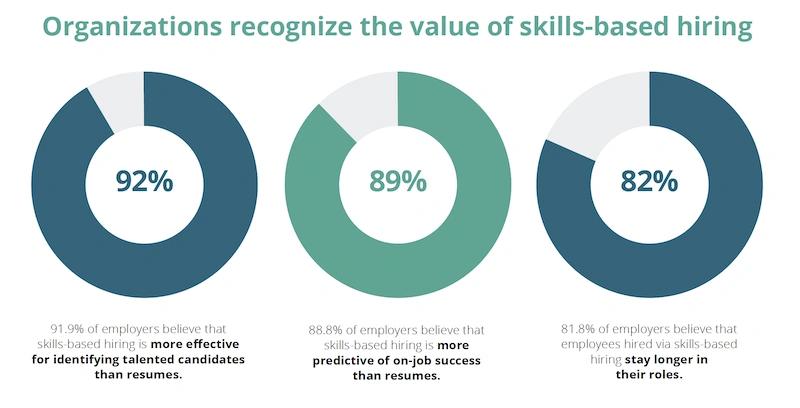
Image Source: The People Space
Skills-based hiring offers a practical solution to today's workforce challenges. This approach creates opportunities for businesses and workers by focusing on capabilities rather than credentials.
1. Reducing bias and expanding access
Hidden biases plague traditional hiring processes. A study shows that 48% of HR managers acknowledge how biases influence their hiring decisions. Degree requirements create needless barriers. Nearly 90% of job postings in growing industries demand bachelor's degrees, even when roles don't need advanced education.
Skills-based hiring creates pathways for over 70 million Americans who developed valuable skills through alternative routes. Military service, community college, workforce training, bootcamps, and on-the-job learning shape these professionals. This benefits underrepresented groups significantly. More than 6 in 10 Black and 5 in 10 Hispanic workers have earned high school diplomas but not bachelor's degrees.
2. Improving candidate-role fit
Skills-based hiring enhances workforce performance. Companies report 90% fewer mishires with this approach. These candidates show stronger outcomes. They perform five times better than those hired based on educational credentials.
Better matches between employee capabilities and job requirements lead to improved retention. The numbers speak clearly - skills-based hires stay with their employers 9% longer than traditional hires.
3. Supporting career switchers
Career changers find valuable opportunities through skills-based hiring. International candidates and self-taught professionals compete based on merit rather than their education background. Problem-solving, communication, and critical thinking become the key differentiators.
4. Encouraging internal mobility
Skills-based approaches boost internal advancement opportunities. Organizations retain institutional knowledge when they evaluate existing employees based on skills rather than credentials. Internal mobility programs help companies match their critical competencies with internal candidates who possess adjacent skills.
Internal mobility combined with upskilling creates growth pathways within organizations. Great Wolf Lodge demonstrates this success. Their entry-level workers advance regularly into middle-skill and management positions.
The benefits of skills-based hiring for employers
Companies that adopt skills-based hiring see measurable returns in multiple business metrics. The benefits go way beyond the reach and influence of just filling positions.
1. Better retention and job satisfaction
Skills-based hiring improves employee retention dramatically. Research shows that employees hired based on skills stay with their organizations 9% longer than those hired through traditional methods. In fact, 91% of employers report better retention rates after switching to skills-based approaches. Job satisfaction increases because candidates find better job fit, which leads to higher levels of participation.
2. Faster and more efficient hiring
Skills-based hiring speeds up recruitment timelines significantly. 82% of companies reduce their time-to-hire after making this move. The data shows that one-third of companies cut hiring time by 18%, while one-fifth slash it by half. Organizations save between 339-660 hours per hire for non-senior roles through this optimization.
3. Increased diversity and inclusion
Teams become more diverse naturally with skills-based hiring. 90% of employers see improved workforce diversity after implementing this approach. Women's representation in talent pipelines grows by 24% in male-dominated industries. Companies with diverse executive teams show 25-36% higher profitability.
4. Stronger team performance
Skills-based hires skills-based hires outperform traditional hires consistently. 94% of companies report that skills-based hires deliver better results than credential-based selections. Skills-based hiring predicts job performance five times more accurately, and companies experience 88% fewer mis-hires.
Skills-based hiring trends and future outlook
Organizations now value capabilities over credentials as the hiring landscape changes faster.
1. Rise in job listings without degree requirements
Companies have dramatically increased job postings without degree requirements. The numbers show a jump from about 21% in 2019 to nearly 30% in 2022—a 36% rise. Financial services, food services, and tech sectors lead this change across industries. U.S. companies now post one-fifth of all jobs without degree requirements.
2. Adoption by major companies and governments
Dell, Accenture, IBM, and Amazon champion skills-based hiring practices. U.S. states have embraced this trend, with over half implementing policies that promote skills-based hiring. Pennsylvania's decision to remove degree requirements from 92% of state positions [link_2] resulted in 60% of new hires without college degrees. Maryland's state government saw a 41% increase in non-degreed hires.
3. Integration with AI and assessment tools
AI tools now analyze candidates' capabilities through natural language processing instead of simple keyword matching. These systems focus on skills and eliminate bias. Interactive assessments test real-life abilities through simulations and adaptive challenges.
4. Long-term impact on workforce development
Skills-based hiring will help fill a projected gap of 6 million workers by 2032. Companies that adopt this approach show 79% higher likelihood of providing positive workforce experiences and 63% better chances of achieving results.
Conclusion
The Great Reshuffle shows how people are changing their views about careers and what matters most in a job. Skills-based hiring has turned out to be the best answer to this workforce transformation. It works well for both employees and employers.
Smart organizations now look at real abilities instead of degrees to predict success. This opens up new paths for millions of workers who learned their skills outside traditional education. On top of that, companies hire faster, keep employees longer, and see better job performance.
Numbers tell the story clearly—companies using skills-based hiring see amazing results. 91% of employers keep their staff longer, and 94% say these hires outperform those chosen based on credentials. This change has spread beyond single companies as whole industries and governments adopt this approach.
Skills-based hiring will be vital to fill workforce gaps through 2032. AI tools are getting better at assessing skills, and major companies are dropping degree requirements. This makes the talent world more open and fair.
Companies that embrace this change now will attract the best talent during the Great Reshuffle. Those stuck on traditional credentials will lose qualified candidates while their competitors build better, more diverse teams. Skills-based hiring creates a perfect match—employers get the right talent and workers find jobs based on their abilities rather than their papers.
Key Takeaways
Skills-based hiring is revolutionizing recruitment by focusing on actual capabilities rather than credentials, creating better matches between talent and opportunities while addressing the Great Reshuffle's workforce challenges.
• Skills-based hiring dramatically improves outcomes: Companies see 88% fewer mis-hires, 50% faster hiring, and 91% better retention rates compared to traditional methods.
• Degree requirements unnecessarily exclude 70+ million qualified workers: Alternative pathways like military service, certifications, and hands-on experience often produce equally capable candidates.
• Performance trumps pedigree: Skills-based hires are 5x more likely to meet job expectations and 94% of employers report superior performance from these candidates.
• The trend is accelerating rapidly: Job postings without degree requirements jumped 36% since 2019, with major companies and governments leading the shift.
• Diversity and efficiency go hand-in-hand: This approach increases workforce diversity by 90% while reducing time-to-hire and building stronger, more inclusive teams.
The Great Reshuffle isn't just about people changing jobs—it's about fundamentally rethinking how we match talent with opportunity. Organizations embracing skills-based hiring position themselves to thrive in this new landscape while creating pathways for previously overlooked talent.