

The True ROI of Skill-Based Hiring: Faster Hiring, Better Retention
Introduction
In today’s competitive job market, every hire matters. For startups and enterprises alike, recruitment ROI (return on investment in hiring) has become a critical measure of success. Traditional hiring methods often rely too heavily on resumes, degrees, and past job titles—factors that don’t always reflect actual skills or job readiness. The result? Costly mis-hires, extended vacancies, and poor retention.
Enter skill-based hiring, a strategy that emphasizes practical ability over credentials. Not only does it improve quality-of-hire, but it also delivers measurable skill-based hiring ROI in terms of reduced costs, faster hiring cycles, and stronger employee retention.
This blog explores the true ROI of skill-based hiring—from cost savings to retention gains—while highlighting actionable strategies and real-world case studies.
Key Challenges with Traditional Hiring
Before we dive into ROI, let’s examine why traditional hiring methods underperform:
- Overreliance on resumes: Only 18% of employers believe resumes reliably reflect required job skills (Deloitte, 2024). This mismatch leads to mis-hires and early attrition.
- Slow processes: Average recruitment cycles last 30–42 days for technical roles, costing up to $6,000 per hire.
- High turnover: Poor job fit often results in early exits, increasing the need for expensive backfilling.
These challenges inflate costs and negatively affect overall recruitment ROI, making skill-based approaches a smarter alternative.
ROI Benefits of Skill-Based Hiring
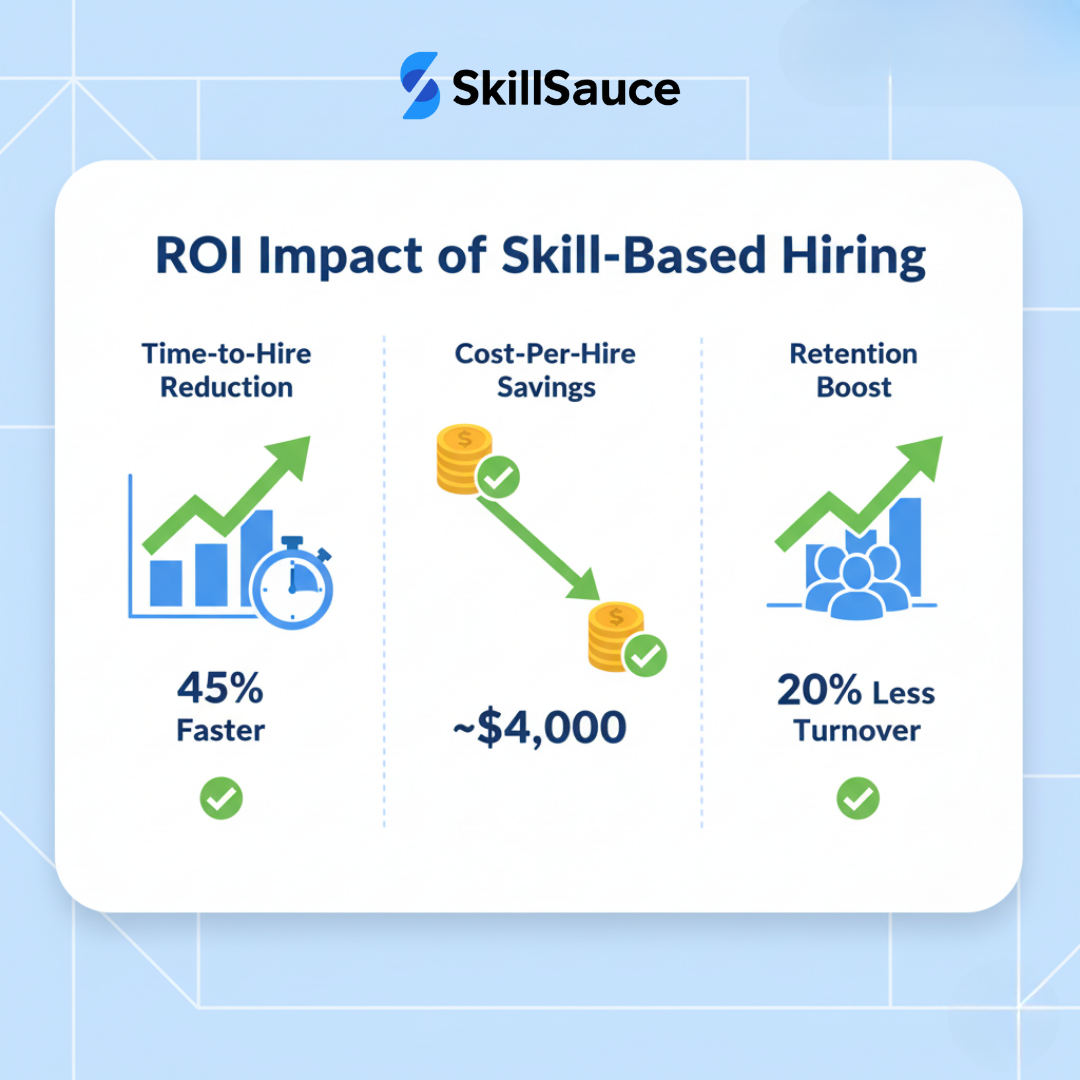
Organizations that adopt skill-based hiring report significant ROI improvements across multiple metrics:
- Reduced time-to-hire: Skill assessments and AI tools cut hiring time by 24–45%, enabling startups and enterprises to fill roles quickly.
- Lower cost-per-hire: Automated assessments save an average of $4,000 per hire, delivering annualized savings in the tens of thousands.
- Improved quality-of-hire: Skills-based hiring is 5× more predictive of performance than traditional methods.
- Higher retention: Companies see 15–25% improvements in retention, with first-year turnover dropping by 20%.
- More diverse talent pools: Skill-first hiring expands access to 3.5× more diverse candidates, supporting DEI efforts.
Together, these outcomes strengthen skill-based hiring ROI, helping organizations do more with fewer resources.
Retention Improvements: The Hidden ROI
Recruitment ROI is not only about faster hiring or cost savings—it’s about keeping great employees.
- Longer tenure: Skills-based hires enjoy 9–15% longer average tenure than resume-screened counterparts (McKinsey, 2024).
- Higher performance: They deliver 18% better on-the-job results, thanks to stronger alignment with role requirements.
- Improved satisfaction: Employees matched on skills feel more engaged, reducing turnover and the need for constant rehiring.
When combined with effective talent retention strategies—like growth opportunities and inclusive cultures—the benefits multiply. Investing in talent retention programs alongside skill-based hiring further boosts ROI by lowering attrition costs.
Cost & Efficiency Data: The Numbers Behind ROI
Skill-based hiring delivers tangible, measurable ROI improvements:
- Cost-per-hire: Averages $7,300 vs. $9,000 using traditional methods—a 19% savings.
- Reduced downtime: Faster hiring saves up to $500 per day in lost productivity from unfilled roles.
- Onboarding efficiency: Skills-matched hires ramp up quicker, reducing training costs and time-to-productivity.
- Turnover savings: Glassdoor’s 2024 survey found skill-based hiring saves an average of $4,000 per hire in reduced turnover expenses.
These numbers prove that the recruitment ROI of skill-based methods isn’t just theoretical—it’s financial reality.
Real-World Case Studies: Skill-Based Hiring in Action
Several leading organizations demonstrate the power of skill-first recruitment:
- PwC UK: Cut hiring time by 45% and boosted female and neurodiverse hires by 20%+.
- US Hospital System: Reduced travel nurse costs by 22%, cut time-to-fill by 24%, and achieved a 96% fill rate.
- CourseCareers (Tech Hiring): Reported a 20% drop in first-year turnover and 25% better retention.
- TestGorilla Survey (2024): Found 78% of employers reduced cost-to-hire, while 73% adopted skills-based hiring within 12 months.
These case studies highlight not only direct ROI but also best employee retention practices, where hiring for skills leads to longer-lasting teams.
Ways to Maximize Recruitment ROI with Skill-Based Hiring
Here are practical steps companies can take:
- Use pre-employment assessments for coding, problem-solving, and real-world projects.
- Integrate psychometric testing to measure communication, collaboration, and cultural fit.
- Adopt AI-driven screening tools to shorten hiring cycles and reduce bias.
- Pair skill-based hiring with retention strategies—career development, flexible work, and recognition programs.
- Track ROI metrics regularly—cost-per-hire, time-to-hire, retention rates, and quality-of-hire.
By combining these steps with ways to increase employee retention, startups and enterprises alike can maximize ROI from both recruitment and retention efforts.
Conclusion
Skill-based hiring is no longer a trend—it’s a business necessity. By focusing on what candidates can do, rather than what’s on their resume, organizations unlock a higher recruitment ROI while simultaneously improving employee retention, diversity, and performance.
Whether you’re building a startup team or scaling an enterprise workforce, investing in skill-based hiring delivers real financial and cultural returns. When combined with talent retention programs and best employee retention practices, the results are clear: faster hiring, lower costs, and stronger, more engaged teams.