


Introduction
The Stack Overflow Developer Survey 2024 reveals that 12.6% of developers now use Rust. This rising trend makes hiring Rust developers a key strategic decision for tech companies.
Rust developers command an impressive average salary of $102,000 per year. This reflects the high value placed on their specialized skills. Tech companies worldwide, from fintechs to cloud providers, need Rust developers to build payment processing systems, microservices, and high-throughput APIs. Finding qualified candidates who can use Rust's unique features to write efficient, reliable code remains a major challenge.
Your company's progress could stall if you hire the wrong Rust developer, leading to delays in critical software deployments. Tech recruiters and hiring managers must know how to identify, review, and select the right talent.
This piece will guide you through each step of hiring exceptional Rust developers. You'll learn everything from defining your needs to avoiding common recruitment mistakes. Let's take a closer look!
Automate Rust Developer Interviews with TESSA AI
Skip the manual screening—TESSA AI conducts structured, bias-free interviews and shortlists the best Rust developers for you.
Book a Free DemoDefine Your Rust Developer Needs
You need a clear picture of what you're looking for before posting a Rust developer job opening. A well-laid-out job description will save your resources and draw qualified candidates to your project.
Clarify project type and scope
Your success in recruiting Rust developers starts with a detailed analysis of your goals, scope, and technical requirements. Here are some vital questions to ask:
- What type of application are you building? (Web services, embedded systems, blockchain, etc.)
- Does your project prioritize performance or memory safety?
- Will the developer work with existing codebases?
- Which Rust features are vital for your project?
Your candidate profile should separate must-have skills from nice-to-have qualifications. To name just one example, developers working on embedded systems or IoT applications should have experience with no_std (no standard library) and embedded-focused crates. You might also need expertise in systems programming, performance optimization, or cross-platform development.
A well-defined set of project requirements helps candidates understand what you expect. This also lets your hiring team focus on resumes that line up with those needs.
Decide between full-time, freelance, or contract
Your choice of employment model will substantially affect your project's success and budget. Each option brings unique benefits based on your situation.
Full-time developers work best for:
- Longer projects or multiple smaller projects where expertise carries over
- Building a strong team culture (companies with high employee engagement are 21% more profitable)
- Complex projects that need deep integration and continuous collaboration
- Ongoing development with changing requirements
Freelance developers shine when:
- Your project has clear boundaries and short timelines
- You need specialists for specific features
- Your budget works better with hourly or project-based billing
- You want to test Rust before making long-term commitments
Rust's relative youth means many companies are still testing the waters. Companies often start with smaller freelance projects before hiring full-time Rust engineers, especially in countries with strict employment laws.
Contract developers bridge the gap by offering dedicated service through B2B arrangements while keeping more flexibility than traditional employment.
Estimate project duration and budget
Good timeline and budget estimates help prevent scope creep and resource shortages. Software project estimation can be tricky, but several methods can guide you.
Rust developer costs vary widely based on experience and location:
- Junior Rust developers typically charge between $50 to $75 per hour
- Mid-level developers might ask for $75 to $100 per hour
- Senior Rust developers with deep expertise can bill $100 to $150 per hour or more
Developer rates change by location. North American and Western European developers usually charge more than their counterparts in Eastern Europe or Asia.
Resources like "Software Estimation: Demystifying the Black Art" or Joel Spolsky's quick estimation technique can help with timeline planning. Atlassian provides useful estimation resources if you work in an Agile environment.
Dedicated Rust developers let you scale your team without compromising quality. Their Rust expertise speeds up onboarding for new team members who know the ecosystem.
Key Skills to Look for in a Rust Developer

Image Source: JetBrains
Finding the right Rust talent requires you to spot developers who blend technical expertise with essential people skills. You need to focus on specific competencies that set exceptional Rust developers apart from average ones.
Proficiency in Rust and Cargo
The foundation of Rust development lies in becoming skilled at the language and its tooling ecosystem. Cargo, Rust's package manager and build system, is vital to the development workflow. It downloads dependencies, compiles packages, creates distributable packages, and uploads them to crates.io. Good developers show expertise with Cargo's command-line tools:
- Using cargo build and cargo check for efficient compilation workflows
- Using cargo test for automated testing
- Using cargo tree to analyze dependencies
- Using cargo clippy to improve code quality
On top of that, look for candidates who know popular crates like tokio for asynchronous programming, serde for serialization, and actix for web development. This knowledge shows they can use battle-tested tools instead of creating everything from scratch.
Understanding of ownership and borrowing
Rust's ownership model stands out as its defining feature. This system "ensures memory safety without requiring a garbage collector". Skilled developers must know:
Ownership rules that control memory allocation and deallocation Borrowing mechanisms that let you access data without transferring ownership Lifetime management to stop dangling references
Ask candidates to explain these concepts during interviews. Let them show how they handle cases with multiple references or complex data sharing patterns. Good developers can state how ownership stops memory leaks and data races.
Experience with async programming
Rust's way of handling asynchronous programming lets you run concurrent code without the weight of multiple threads. Developers should know about:
The Future trait and its role in asynchronous computations The right way to use async/await syntax for non-blocking operations Working with async runtimes like Tokio or async-std
This skill matters especially when you have many network requests or I/O operations. Candidates should explain how Rust's async model is different from other languages and helps use resources well.
Familiarity with system-level programming
Rust shines at systems programming. You need developers who grasp low-level programming concepts. They should feel at ease working with OS interfaces and managing resources like memory and threads directly. Search for experience in:
Memory management without garbage collection Low-level optimization techniques Cross-platform development considerations
People with background in embedded systems, operating system development, or speed-critical applications often have these skills.
Soft skills like communication and prioritization
Technical skills alone aren't enough. Good Rust developers need strong people skills. Rust has a steep learning curve, so persistence and adaptability are vital traits.
Also check for:
Skills to explain complex technical ideas to non-technical team members Problem-solving abilities to tackle Rust's unique challenges Team skills for code reviews and shared development
One programming expert said, "Out of all the things and technologies I've learned in my software engineering career, the single thing that made me the most money, bar none, was soft skills". A developer's ability to state technical decisions, set task priorities, and work with others determines how well they fit your team.
These five skill areas will help you find Rust developers who can build robust, efficient, and maintainable code for your projects.
Test Rust Skills Instantly with AI-Crafted Assessments
Don’t guess—assess! Use SkillSauce’s AI-built Rust assessments to evaluate coding ability, problem-solving, and technical depth—automatically.
Try Rust AssessmentsWhere and How to Find Rust Developers
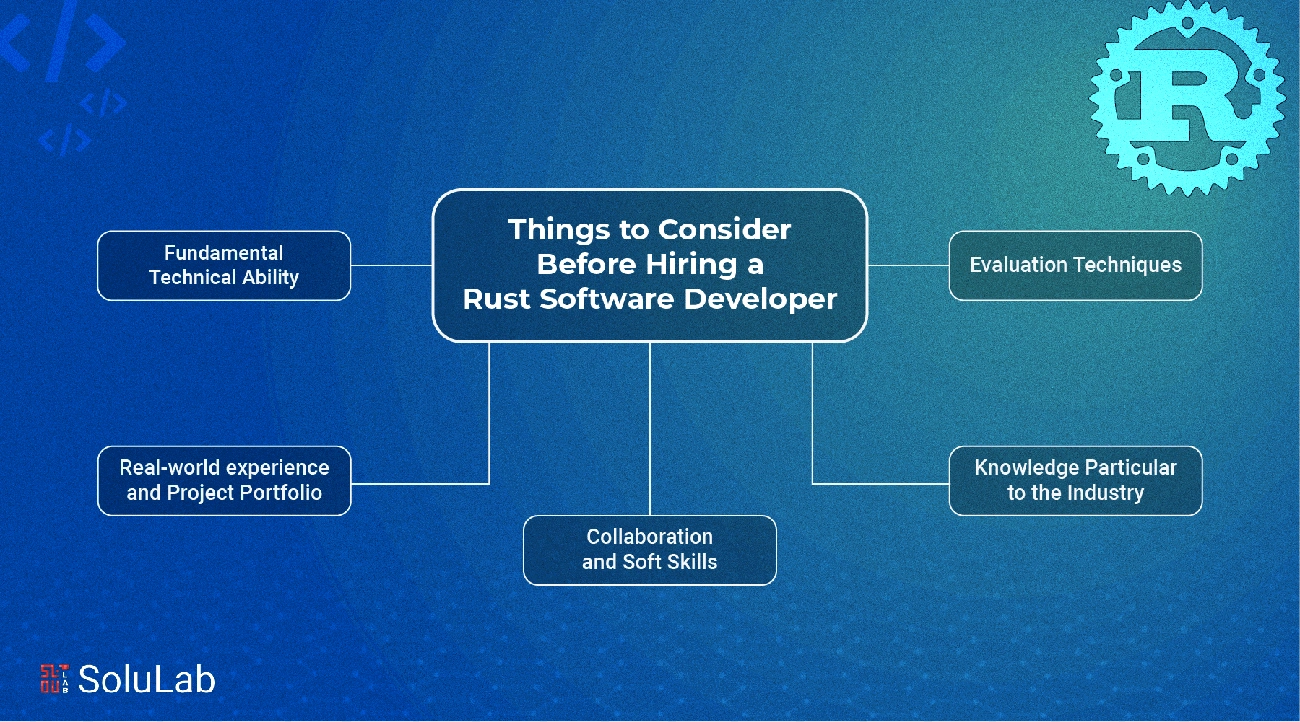
Image Source: SoluLab
Finding qualified Rust developers needs a good understanding of where to look. The growing yet limited supply of Rust talent means recruiters must use multiple channels to connect with the right candidates.
Use job boards and developer communities
Your search should begin on specialized Rust job boards that attract developers who look for Rust opportunities:
- RustJobs.dev: A dedicated platform featuring the latest Rust positions
- LetsGetRusty.com: Hosts hundreds of Rust positions ranging from junior to senior levels, with filtering options for remote, hybrid, or on-site roles
The active Rust communities offer more than just job boards. The Rust Programming Language Community Discord server has over 63,000 members who discuss Rust development actively. Forums like users.rust-lang.org and the r/rust subreddit provide spaces where developers share knowledge and career interests.
Explore GitHub and Stack Overflow profiles
GitHub helps identify skilled Rust developers effectively. Trending Rust repositories show active contributors who prove their ground expertise. Their code quality, documentation practices, and how they work together through pull requests and issue discussions tell a lot about their skills.
Stack Overflow proves valuable too. Developers who give high-quality answers to Rust-related questions usually have deep technical understanding and communication skills—both vital attributes for team integration.
Use LinkedIn and Rust dev groups
LinkedIn has several active Rust communities ready to connect you with potential candidates. The main "Rust Programming Language" group has grown to over 27,500 members as of mid-2025. Other notable groups include "Rust Developer Community" with more than 6,200 members and "Rust Developers" with around 1,500 members.
Start by looking for developers who list Rust in their skills or have Rust-related experience. Then get involved with content in these groups to build relationships before making direct hiring approaches.
Think about freelance platforms for short-term needs
Projects with clear scope or experiments with Rust might need freelance platforms that offer flexibility. General marketplaces like Upwork and Fiverr have Rust developers, though top talent often stays away from these platforms due to bidding wars.
So, platforms like Arc that carefully check their Rust developers can match you with senior developers in about 72 hours. Gun.io offers another good choice, with an average time-to-hire of 13 days.
The hiring platforms differ in their specialization and fee structures. A mix of job boards, community involvement, and specialized recruitment services works best most times.
How to Evaluate and Test Candidates
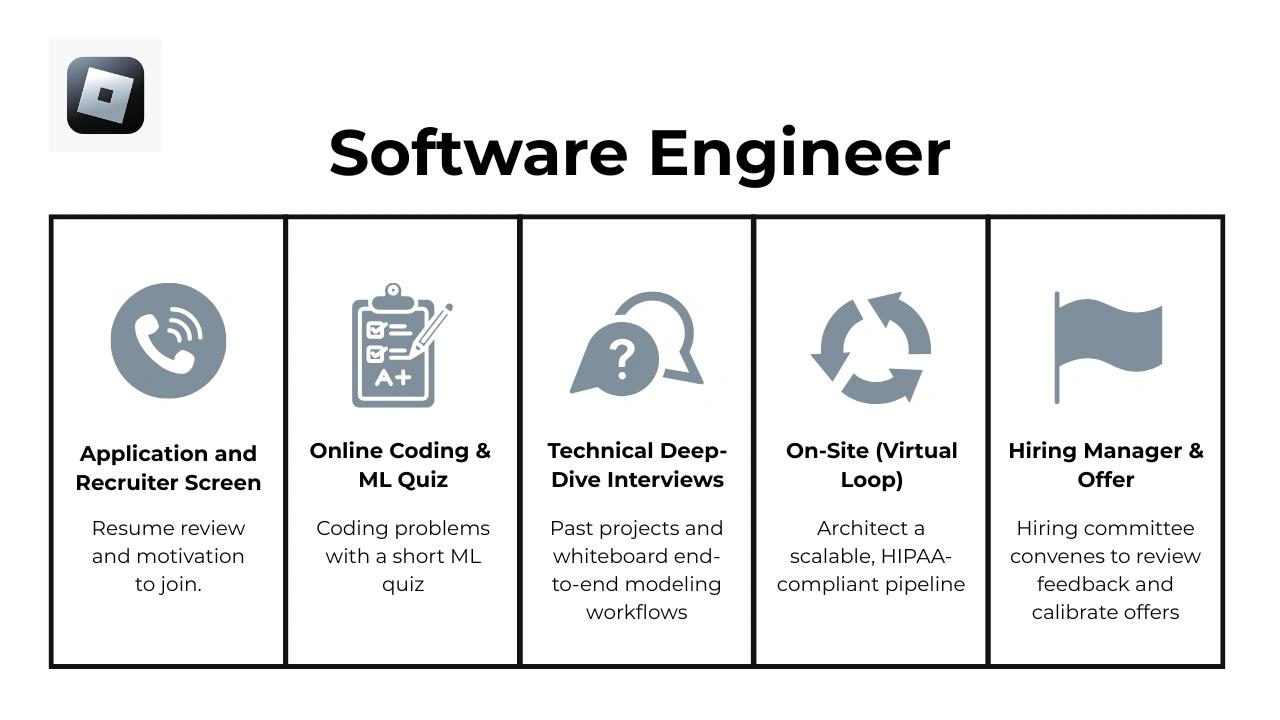
Image Source: Interview Query
Your next crucial step starts after gathering potential Rust candidates. A good assessment approach helps you find developers who match your project requirements.
Use coding assessments and technical interviews
Technical assessments show you a candidate's Rust proficiency objectively. Your coding challenges should test their grasp of Rust's syntax, memory safety features, and problem-solving skills. The assessments can range from simple algorithm tasks to complex problems that need advanced Rust knowledge.
Ask candidates to walk through their problem-solving approach. Their explanation reveals both their thinking process and communication abilities. The code's quality, readability, and performance optimization matter a lot, given Rust's focus on efficiency.
Check open-source contributions
A look at a candidate's contributions to open-source Rust projects shows their real-life capabilities. You'll see the depth of their projects, participation level, and code quality. Developers who take part in the Rust community often show better expertise and stay up-to-date with best practices.
Assess soft skills and team fit
Technical skills aren't everything. You need to know how candidates handle group problem-solving. Their experience with debugging tough issues or teamwork matters. Research shows that developers who participate in programming communities tend to have higher skill levels.
Use platforms like TestGorilla for structured testing
Pre-employment testing platforms give you standardized ways to assess candidates. TestGorilla offers expert-made coding tests that check Rust developers' abilities. Their library has:
- Rust programming technical assessments
- Backend developer tests covering clean coding and algorithms
- Soft skills evaluations for communication and prioritization
SkillSauce helps HR teams, recruiters, and tech leads hire better and faster through AI-led interviews and custom Rust assessments. Request a Demo today.
These platforms let you build custom assessments that combine different test types and often include one-way video interviews with coding challenges. This well-laid-out approach cuts technical screening time by up to 85%.
Common Hiring Mistakes to Avoid
Technical talent recruitment comes with many pitfalls that can derail your best-laid plans. You'll make better hiring decisions for your Rust development team by learning about these common mistakes.
Focusing only on technical skills
A candidate's Rust coding skills might look great on paper, but they mean little if the developer can't set priorities, work with team members, or talk clearly to project managers. Technical skills matter, but a developer's impact stays limited without the right people skills. Companies that look for soft skills during their technical recruitment keep employees 50% longer. A developer's real value often depends on how well they explain complex ideas and fit into your team structure.
Ignoring culture fit and communication
Finding the right cultural fit matters just as much as checking technical skills. Some developers do their best work in high-pressure environments, while others shine in more relaxed settings. Companies with high employee participation make 21% more profit. This shows how much the right cultural fit affects the bottom line. Good communication helps teams work better together, especially when dealing with Rust's complex ownership concepts.
Overlooking project-specific experience
Domain expertise sets great candidates apart from good ones. Your specialized projects need developers who know your specific field, whether it's embedded systems, web development, or blockchain technology. This focused background helps developers add value from day one. They understand both the technical hurdles and your project's business needs.
Conclusion
A thoughtful, multi-faceted approach beyond technical assessment alone will help you hire the right Rust developers. Your project's requirements will set the foundation for successful recruitment. A detailed evaluation of technical prowess and soft skills will give a clear picture of candidates who can deliver real value.
Tech leaders should know that exceptional Rust developers combine language mastery, systems thinking, and collaborative abilities. Your recruitment strategy should utilize multiple channels to connect with qualified talent in this growing yet competitive field. Job boards and developer communities can help you find the right candidates.
Finding the right cultural fit and looking beyond technical abilities will strengthen your hiring outcomes. The best teams balance technical excellence with strong communication skills and domain expertise. SkillSauce helps HR teams, recruiters, and tech leads hire smarter and faster through AI-led interviews and custom Rust assessments. Request a Demo today.
These practices should become part of your Rust developer recruitment process. Your careful hiring approach will reward you with reliable, efficient code, reduced technical debt, and smooth team integration. Time spent finding the right Rust talent now will substantially improve your project outcomes and technical capabilities in the years ahead.
Key Takeaways
Here are the essential insights for successfully hiring Rust developers in today's competitive tech landscape:
• Define project scope first: Clarify your specific Rust needs, project type, and employment model before posting jobs to attract qualified candidates.
• Assess ownership mastery: Evaluate candidates' understanding of Rust's unique ownership and borrowing system—this separates skilled developers from beginners.
• Use multiple sourcing channels: Leverage specialized job boards like RustJobs.dev, GitHub profiles, and active Rust communities to find quality talent.
• Balance technical and soft skills: Don't focus solely on coding ability—communication, teamwork, and cultural fit are equally crucial for project success.
• Test real-world capabilities: Use structured coding assessments and review open-source contributions to evaluate practical Rust development skills.
The Rust developer market is growing rapidly, with developers commanding premium salaries averaging $102,000 annually. Success in hiring requires understanding both the technical complexities of Rust and the collaborative skills needed for effective team integration. Companies that invest time in comprehensive evaluation processes—combining technical assessments with cultural fit analysis—consistently build stronger development teams and achieve better project outcomes.
Build Your Rust Team Faster with SkillSauce
From AI-led interviews to custom Rust assessments—SkillSauce helps HR teams, recruiters, and tech leads hire smarter and faster.
Request a Demo