

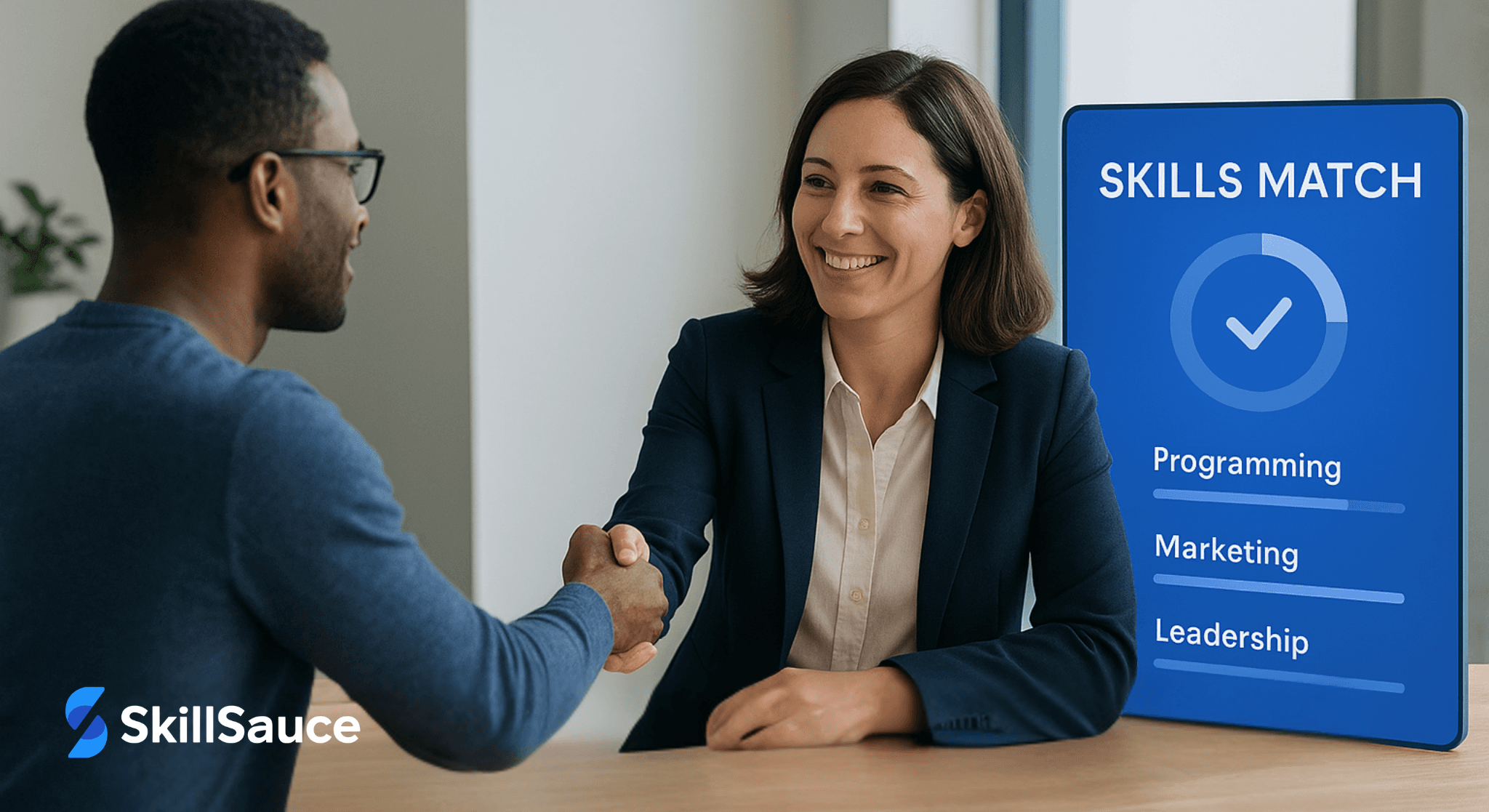
In today’s competitive startup ecosystem, every hire has an outsized impact. Traditional resume-based recruitment often fails to capture real-world capabilities, leading to costly mis-hires. That’s why skill-based hiring and structured assessments are quickly becoming the default approach for startups building agile, high-performing teams. Backed by AI-driven insights and real case studies, this hiring model is redefining how young companies identify, evaluate, and retain top talent.
Why Skill-Based Hiring & Assessments Matter for Startups
- Beyond resumes: Startups cannot afford guesswork. Skills-based hiring prioritizes what a candidate can do—their coding ability, problem-solving skills, and communication—over what university they attended. This approach cuts through the noise and gets straight to a candidate’s real-world capabilities.
- Access to broader talent pools: By removing rigid degree requirements, you instantly open the door to a more diverse and skilled talent pool. This is crucial for finding hidden gems who might have learned their skills through bootcamps, self-study, or hands-on projects.
- Proven performance: Research consistently shows that skills-first hires ramp up faster and stay with companies longer. A recent study found these employees have an average retention of 4.7 years vs. 4.3 years for traditional hires.
Types of Assessments Startups Can Leverage
- Coding Tests: Evaluate a developer’s proficiency in specific programming languages, frameworks, and data structures. These can range from automated tests to live, collaborative coding sessions.
- Live Problem-Solving Tasks: Also known as take-home projects, these tasks simulate real job demands. For a product manager, this might involve outlining a product roadmap; for a marketer, it could be a small campaign strategy.
- AI-Powered Assessments: These adaptive tests use AI to automatically score technical and soft skills, providing objective data and accelerating the initial screening process.
- Behavioural & Culture-Fit Evaluations: Using tools like personality assessments (e.g., DISC or OCEAN) and structured behavioural interviews, you can gauge a candidate's adaptability, collaboration style, and overall fit with your team culture.
- Portfolio & Open-Source Reviews: For roles like developers and designers, reviewing their public portfolio, open-source contributions, or a personal website offers a direct look at their work quality and passion.
Tip: For a truly holistic view, combine technical assessments with behavioural evaluations. This gives you a complete picture of both a candidate’s skills and their potential as a team member.
Case Studies: Startups & Enterprises Leading the Way
- Google & HubSpot: Both companies are known for their rigorous, hands-on hiring processes. They blend technical challenges with extensive behavioural interviews, leading to higher performance and better team cohesion.
- Indian IT Leaders (TCS, Accenture, Capgemini): These firms have successfully used gamified and virtual assessments on a massive scale to reduce time-to-hire by weeks and improve the job readiness of their new hires.
- Stakefield (Silicon Valley Startup): This startup used structured, multi-step assessments to build a product-ready tech team in just 6 weeks, demonstrating how this approach can be a game-changer for speed and efficiency.
Benefits of AI-Driven Assessment Platforms
- Speed & Efficiency: AI can shortlist qualified candidates in a fraction of the time, cutting your time-to-hire by up to 90%.
- Reduced Bias: A skills-first, data-driven approach removes subjective human bias, leading to a more diverse workforce. Companies that implement this often see a 67% increase in hiring diversity.
- Significant Cost Savings: By minimizing reliance on expensive third-party recruiters and reducing mis-hires, startups can save up to 75% on recruitment costs.
- Retention: Employees who are hired based on a proven skill match are more likely to be satisfied and successful in their roles, resulting in up to 50% lower turnover rates.
Challenges Startups Face (and Practical Solutions)
| Challenge | Impact | Solution |
|---|---|---|
| Scaling Assessments | Difficult to handle high candidate volumes manually | Adopt AI-powered platforms with automation to manage and score tests. |
| Budget Constraints | SaaS-based tools may feel expensive | Choose modular, pay-per-use platforms |
| Bias in AI | Risk of reflecting historical datasets | Combine AI-driven screening with human review and regular audits to ensure fairness. |
| Candidate Experience | Overly long or complex tests can deter top applicants. | Keep assessments short, job-specific, and provide timely, respectful feedback. |
Best Practices for Startup Assessment Design
- Align with Real Tasks: Make sure every assessment directly mirrors a task the employee will perform on the job.
- Respect Candidate Time: Keep tests insightful but concise. Value their time, and they will value you.
- Automate Early, Humanize Later: Use automation for initial screening, but always keep the final interviews and decisions in human hands.
- Track & Iterate: Continuously refine your assessment process based on the performance and feedback of the people you hire.
The Future of Startup Hiring (2025–2030)
- Skills-first hiring becomes the default across industries, not just in tech giants.
- Micro-credentialing and adaptive testing refine candidate evaluation in real time.
- AI + Human judgment = more personalized, predictive, and fair hiring.
- Policy momentum: Governments (US, India, EU) are pushing for skills-first models in both public and private sectors.
Final Thoughts
For a startup, every single hire is an investment in its future. By embracing skills-based hiring, augmented by structured, AI-driven assessments, you can build a more resilient, innovative, and cost-effective team. It's time to move beyond the resume and start focusing on what truly matters: proven capabilities.
CTA Suggestion for Blog End: Ready to make smarter hiring decisions? Discover how SkillSauce helps startups scale with skills-first hiring.