


How to Make Your Remote Recruiting Processes Faster and Smarter
Our experience working with scaling teams shows that the largest obstacle in remote recruiting isn't finding talent—it's the process itself. The shift to global, remote-first work has made speed and consistency non-negotiable. This guide outlines the essential workflow changes and automation levers that allow modern recruiters to stop chasing emails and start focusing on strategic hiring.
1. The New Era of Remote Recruiting: Efficiency is Everything
The remote recruiting process is now the central stage for global talent acquisition. As competition for specialized talent intensifies, recruiters face complex coordination challenges across time zones and diverse teams. Every minute spent on administrative tasks is a minute lost on engaging a top candidate.
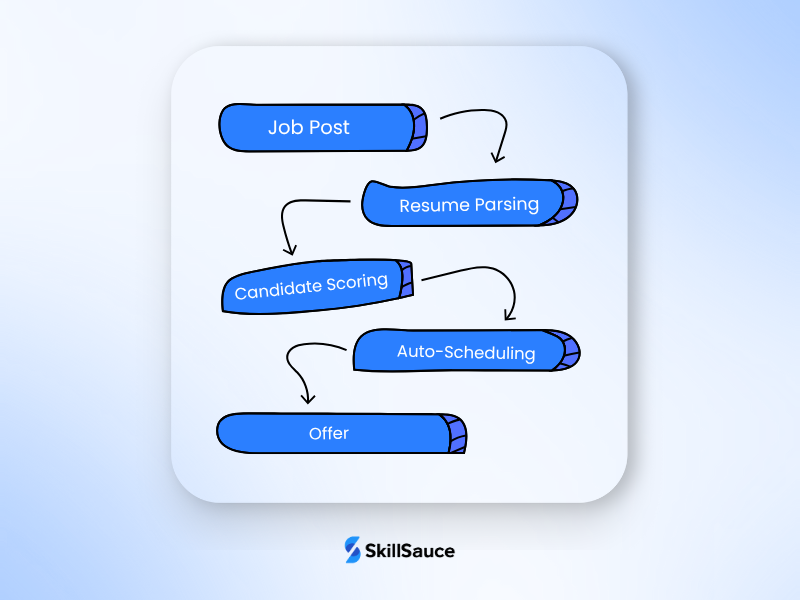
Today’s smart workflows, powered by automation and data, are rewriting the rules. By reducing manual tasks and injecting data-backed insights, companies can build hiring processes that are faster, smarter, and inherently fairer.
2. The High Cost of Traditional Remote Recruiting
Before automation became standard, remote recruiting relied heavily on manual, time-consuming processes. Recruiters often spent up to two-thirds of their day on repetitive administrative work—including emailing, scheduling, and chasing feedback.
These inefficiencies created critical bottlenecks:
- Scattered Communication: Feedback and candidate data were fragmented across multiple tools and platforms.
- Inconsistent Candidate Experience: Communication delays led to confusion and higher candidate drop-off.
- Delayed Hiring Feedback: Slow feedback loops pushed the average time-to-fill to nearly 38 days.
In a market where top talent often accepts offers within a week, slow recruiting equals lost opportunities.
3. How Automation Makes Remote Recruiting Faster
Automation is the true game-changer in achieving remote recruiting speed. Leveraging modern Applicant Tracking Systems (ATS) and specialized automation tools eliminates repetitive, low-value tasks.
Key Automation Benefits
Organizations using this level of automation report up to 30% faster time-to-hire, freeing up recruiters to focus on strategic conversations and relationship-building.
4. How Data and Analytics Make Remote Recruiting Smarter
Data analytics and integrated intelligence turn recruiters into strategic analysts. Instead of relying on intuition or "gut feelings," every decision is based on measurable, verifiable evidence.
How Analytics Enhances Recruiting Intelligence:
- Predictive Matching: Tools use historical performance data to match candidates with roles that best fit their skill trajectories and organizational needs.
- Automated Evaluation: ML-based assessment systems analyze technical and behavioral competencies instantly, flagging key strengths or early risks.
- Real-Time Dashboards: Recruiters monitor critical KPIs like interview drop-offs, time-spent-per-stage, and funnel conversion rates instantly, allowing for on-the-fly process refinement.
Platforms like SkillSauce, Greenhouse, and Recruitee empower teams with pipeline analytics that refine hiring decisions, reduce bias, and promote predictable, successful outcomes.
5. Practical 6-Step Workflow to Streamline Your Remote Recruiting
Optimizing the remote recruiting process doesn’t always require expensive new software—it requires smarter integration and consistency.
- Centralize Operations with a Core ATS: All candidate data, feedback, scheduling, and communication must live in one cloud platform.
- Automate Sourcing & Screening: Deploy AI tools to automatically filter, rank, and prioritize the top 10-20% of applicants immediately after application.
- Implement Automated Assessments: Use pre-employment assessments (like SkillSauce's) to qualify candidates before the human interview stage, drastically reducing time spent on unsuitable candidates.
- Simplify Interview Scheduling: Integrate automated calendar tools across all interviewers to prevent bottlenecks and ensure a smooth candidate experience.
- Engage with Conversational AI: Use chatbots or automated messaging to keep candidates informed, answer FAQs, and maintain momentum during lag periods.
- Track Data Metrics Rigorously: Continuously monitor KPIs like time-to-fill, interview-to-hire ratio, and quality-of-hire for continuous, data-driven optimization.
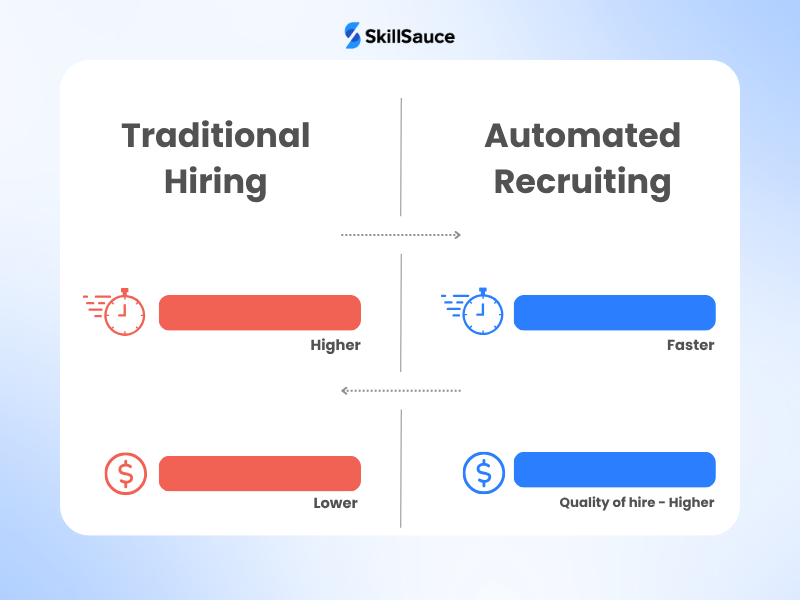
| Parameter | Traditional Process | Automated / AI-driven Process |
|---|---|---|
| Time-to-Fill | Typical: 38 days (complex tech roles). | With automation: 22–28 days — 20–35% faster. |
| Hiring Cost | Higher due to manual coordination and longer vacancy periods. | Reduced administrative hours and improved throughput — ~25% lower cost on average. |
| Quality of Hire | Variable — depends on manual screening and interview consistency. | Improved retention & fit through data-led matching and AI-assisted assessments — better long-term outcomes. |
6. Conclusion: Building a Future-Ready Remote Recruiting Process
In today’s market, remote recruiting success depends entirely on how efficiently teams adopt automation, intelligence, and data-driven systems. Recruiters who modernize their workflows can cut time-to-hire, improve candidate experiences, and directly drive long-term retention.
By centralizing recruitment, leveraging analytics, and automating repetitive steps, companies can create a seamless hiring experience that matches the speed and complexity of modern, global business. The smarter your process, the stronger your team.
Ready to build an automated, intelligent recruiting workflow? Explore how SkillSauce helps optimize your hiring pipeline.