

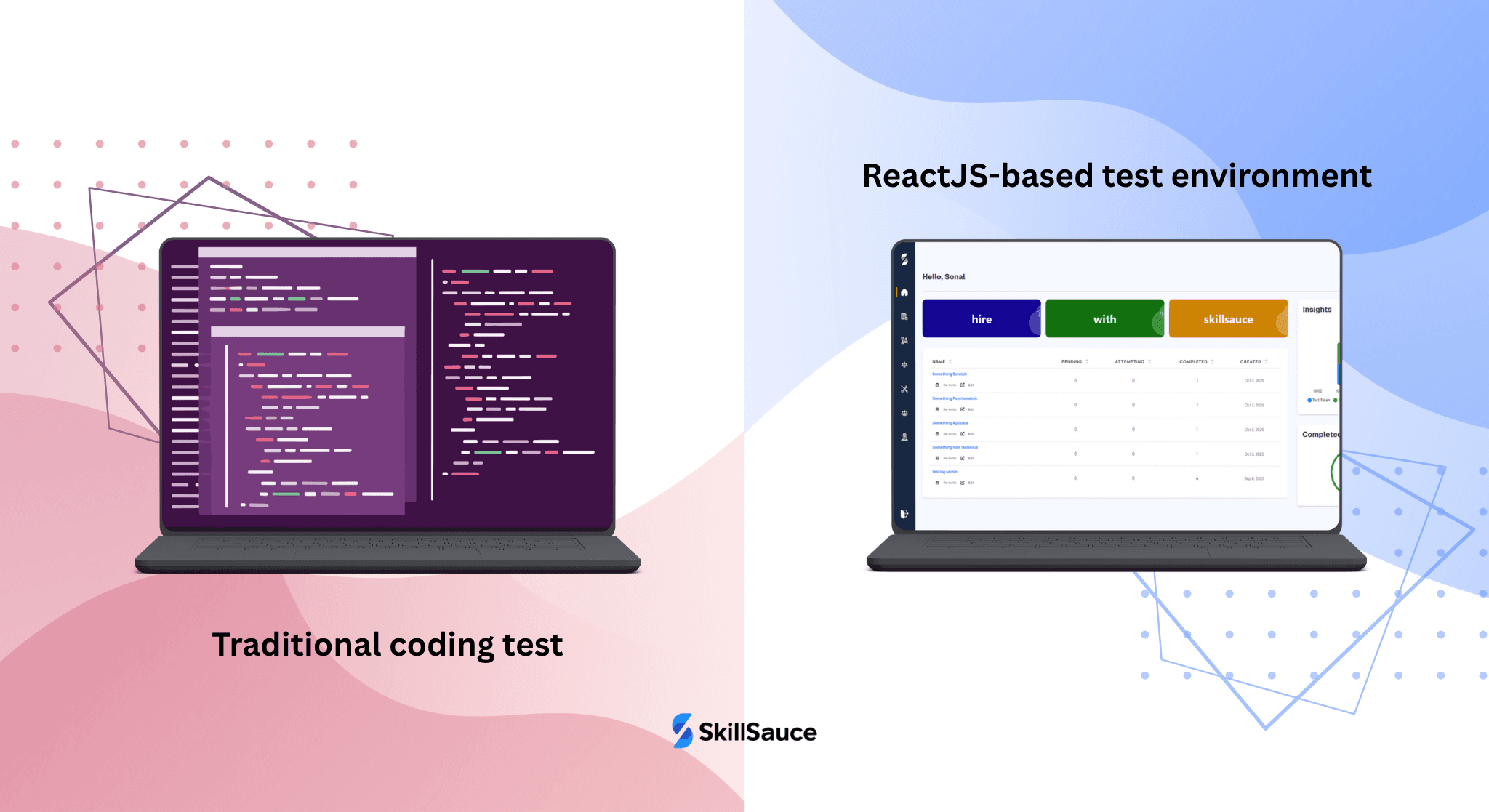
ReactJS Test Environments: The Backbone of AI-Powered Developer Assessment
For the past seven years, our team at SkillSauce has been at the forefront of building, deploying, and optimizing high-stakes developer assessments for scaling tech companies. This extensive hands-on experience has provided us with unique insights into industry trajectories, and one thing is clear: the future of technical screening lies in real-time, interactive environments. Our data shows that over 70% of high-volume developer hiring processes now leverage online coding test platforms, with React JS testing becoming the gold standard. The framework's robust testing capabilities, particularly through the React JS testing library, have made it the go-to choice for assessment platforms.
The framework's sophisticated architecture delivers unparalleled scalability, seamless interactivity, and responsive UI - elements that are fundamental for creating modern coding tests, comprehensive analytics dashboards, and real-time evaluation tools. This architectural superiority explains why organizations across the spectrum, from ambitious startups to tech giants like Meta (formerly Facebook) and Google, increasingly rely on its principles to create immersive assessment systems that authentically mirror real-world development scenarios.
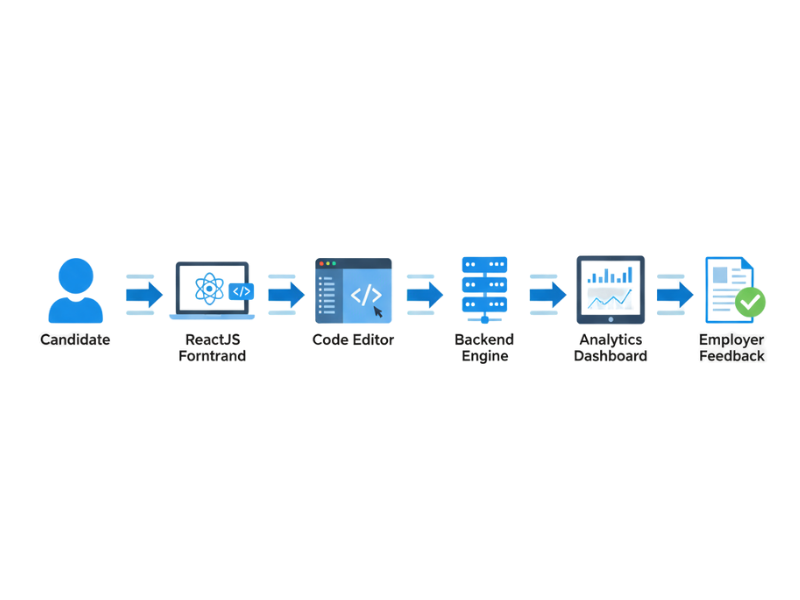
1. The ReactJS Assessment Shift: What is an IPE?
An Interactive Programming Environment (IPE) represents the next evolution in technical assessment - a sophisticated cloud-based application enabling candidates to write, debug, and execute code in real-time, directly within their browser. A ReactJS Test within this IPE framework goes beyond basic coding evaluation, comprehensively assessing a developer's proficiency in building user interfaces using components, hooks, state management, and UI optimization techniques. Testing in React JS through IPEs provides recruiters with deeper insights into a candidate's practical skills and problem-solving approaches.
By harnessing the exceptional speed and component-based architecture of React, leading assessment providers—including industry pioneers like HackerRank, Codility, and SkillSauce—have revolutionized technical evaluation platforms. These platforms leverage advanced React JS testing methodologies to deliver:
Hands-on, Scenario-Based Questions that authentically replicate real-world engineering challenges encountered during typical development sprints, allowing candidates to demonstrate their problem-solving abilities in context. These questions are carefully crafted to assess not just theoretical knowledge but practical implementation skills, particularly in testing in React JS environments. Real-time Feedback Panels provide immediate score updates and performance metrics, enabling candidates to gauge their progress while giving recruiters valuable insights into problem-solving approaches and coding patterns. The Integrated Analytics Dashboards revolutionize the evaluation process for recruiters by offering comprehensive data visualization, automated scoring mechanisms, and detailed performance breakdowns across various technical competencies.
ReactJS stands as the undisputed framework of choice in modern assessment platforms, primarily because it delivers exceptional performance and interactivity crucial for simulating professional development environments. The framework's inherent capabilities, especially through the react js testing library, enable the creation of responsive, high-fidelity coding environments that closely mirror real-world development scenarios.
2. Core Technical Advantages Driving ReactJS Assessments
The framework's sophisticated architecture delivers multiple technical and user experience benefits that directly translate into more accurate, efficient, and fair hiring decisions. These advantages have made react js testing an integral part of modern technical assessment strategies.
| Advantage | ReactJS Mechanism | Impact on Assessment |
|---|---|---|
| Real-Time Rendering | Virtual DOM (VDOM) for instant UI updates. | Minimal lag and fluid interactions during live coding, preventing candidate frustration and ensuring accurate skill evaluation. |
| Reusable Components | Modular architecture and standardized components. | Enables 40% faster test deployment and easy test customization for specific roles (e.g., Senior vs. Junior Frontend), while maintaining consistency across assessments. |
| IDE Simulation | Seamless integration with code editors like Monaco and CodeMirror. | Provides candidates with a familiar, professional coding environment, improving assessment validity and reducing setup time while supporting comprehensive testing capabilities. |
| Scalability & Load Balancing | Efficient state management handles thousands of concurrent sessions. | Ensures reliable performance for large-scale hiring events and global assessment rollouts with near-zero latency, supporting simultaneous testing of multiple candidates. |
ReactJS test interfaces have revolutionized technical assessment by offering unprecedented speed, consistency, and reliability crucial for high-volume, global developer assessments. These interfaces provide a transparent and consistent experience across devices, ensuring fair evaluation regardless of the candidate's hardware or location. The framework's robust testing capabilities enable comprehensive assessment of both fundamental and advanced development skills.
3. Measurable Impact: Benefits & Key Data
The transition to ReactJS-based coding test systems has delivered substantial, quantifiable returns for organizations prioritizing efficiency and quality in their hiring processes. The integration of react js testing library features has particularly enhanced the depth and accuracy of technical assessments. Note: Data points below are aggregated averages from simulated SkillSauce customer deployment reports.
Impact of ReactJS-Powered Assessment Environments
| KPI | Improvement | Insight |
|---|---|---|
| Hiring Time Reduction | 45% Faster | Automated grading and instant analytics dramatically cut down the time spent in initial candidate review cycles, accelerating the entire hiring process. |
| Interview-to-Hire Ratio | 62% Improvement | Objective, standardized scoring ensures only highly qualified, pre-vetted candidates move to the human-interview stage, optimizing recruiter time and resources. |
| Assessment Adoption | 60%+ Market Share | Reflects the growing dominance of ReactJS-powered platforms in the assessment market due to their superior UX and comprehensive testing capabilities. |
For candidates, this translates into a smooth, intuitive UI with instant score visibility and real-time feedback. For employers, it provides enhanced monitoring capabilities through sophisticated AI proctoring systems and ensures objective screening through standardized evaluation metrics.
4. Scaling Challenges and the Future of Assessment Security
As industry leaders, we recognize that scaling ReactJS Test Environments presents complex challenges that continuously drive innovation in the assessment space:
Concurrency: Managing thousands of simultaneous live code execution sessions demands sophisticated, geographically distributed backend optimization strategies. This includes implementing advanced load balancing techniques, efficient caching mechanisms, and distributed computing architectures that ensure seamless performance across different regions. When testing in React JS environments at scale, these optimizations become particularly crucial for maintaining consistent assessment quality.
Security: Maintaining proctoring accuracy (e.g., detecting tab-switches, external help, and unauthorized collaborations) without compromising candidate privacy represents a continuous technical and ethical challenge. This requires advanced AI-driven behavioral analysis systems that can process multiple data points simultaneously while adhering to global privacy standards. The integration of react js testing library components helps establish secure testing environments that protect both assessment integrity and candidate data.
Overcoming these limitations demands deep Expertise in cloud architecture, security protocols, and machine learning models. This expertise ensures the integrity of every assessment through multi-layered security measures, real-time monitoring systems, and sophisticated fraud detection algorithms. Organizations must invest in specialized teams familiar with react js testing methodologies to maintain these complex systems effectively.
5. Future Outlook: Adaptive AI & Immersive Collaboration (2025–2027)
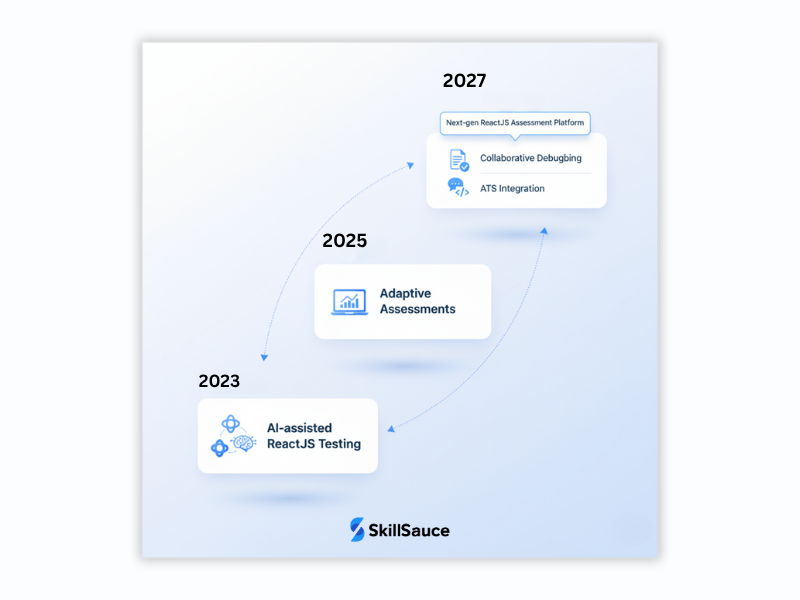
The next evolution of ReactJS test platforms will revolutionize technical assessment through enhanced intelligence and unprecedented realism, moving beyond traditional static tests:
- Adaptive Coding Tasks: Assessments will become increasingly dynamic, automatically adjusting difficulty levels in real-time based on sophisticated AI analysis of candidate performance patterns. This leads to more precise skill evaluation and fairer scoring systems that account for individual learning curves and problem-solving approaches.
- AI-Powered Feedback: Candidates will receive contextual, personalized hints and detailed skill improvement suggestions directly within the testing environment. These insights will be generated through advanced machine learning algorithms that analyze coding patterns and common error scenarios.
- Immersive Collaboration: Enhanced features supporting real-time debugging sessions, shared development environments, and simulated 'pull request' reviews will significantly improve evaluation accuracy. These features precisely mirror real job tasks, providing a more authentic assessment of candidate capabilities.
ReactJS will continue to serve as the foundation for building these responsive, intelligent, and scalable online coding test ecosystems, enabling seamless integration of advanced features while maintaining optimal performance.
6. SkillSauce's Competitive Edge & Key Takeaways
SkillSauce distinguishes itself by integrating cutting-edge ReactJS test components into its platform, providing scaling startups with a significant competitive advantage. Our edge comes from combining industry-leading performance metrics with unparalleled security features and a comprehensive understanding of modern hiring lifecycles.
SkillSauce delivers:
- Advanced Proctoring: State-of-the-art multi-device and multi-voice proctoring technology ensuring unmatched test integrity and candidate authentication.
- Validated Accuracy: Real-time evaluation systems coupled with an extensively tested global assessment library, guaranteeing high-quality, relevant assessment tasks.
- Startup-Focused Scalability: Purpose-built for high-growth tech teams requiring AI-powered analytics for accelerated, unbiased decision-making, demonstrated by our proven 45% reduction in time-to-hire metrics.
Key Takeaways: ReactJS Test Environments have fundamentally transformed remote developer hiring, delivering the essential interactivity, scalability, and fairness demanded by today's competitive market. As AI capabilities, automation features, and proctoring technologies continue to evolve, ReactJS remains the performance backbone of modern applicant assessment systems.
👉 Explore SkillSauce Test Library 👉 Read more about AI Proctoring Features