

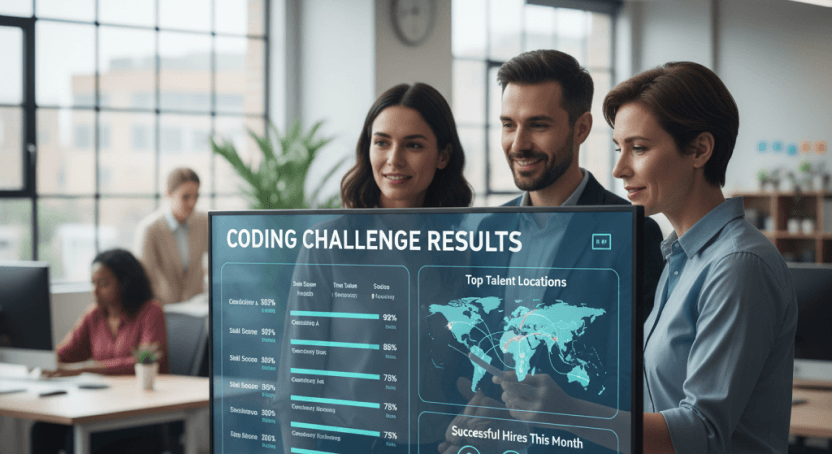
The Future of Developer Hiring: Why Programming Challenges are Essential
1. What Are Programming Challenges? Defining the Modern Technical Assessment
Programming challenges, often referred to as coding challenges or skill assessments, are standardized, online technical tasks designed to simulate real-world software development problems. They are a critical component of modern tech recruitment, testing a candidate’s practical ability to solve problems using actual code, rather than relying solely on abstract knowledge or theoretical discussion.
These challenges move the hiring focus from what a candidate knows (as written on a résumé) to what they can actually do under conditions that mirror the job environment.
Programming Challenges vs. Coding Tests vs. Traditional Interviews
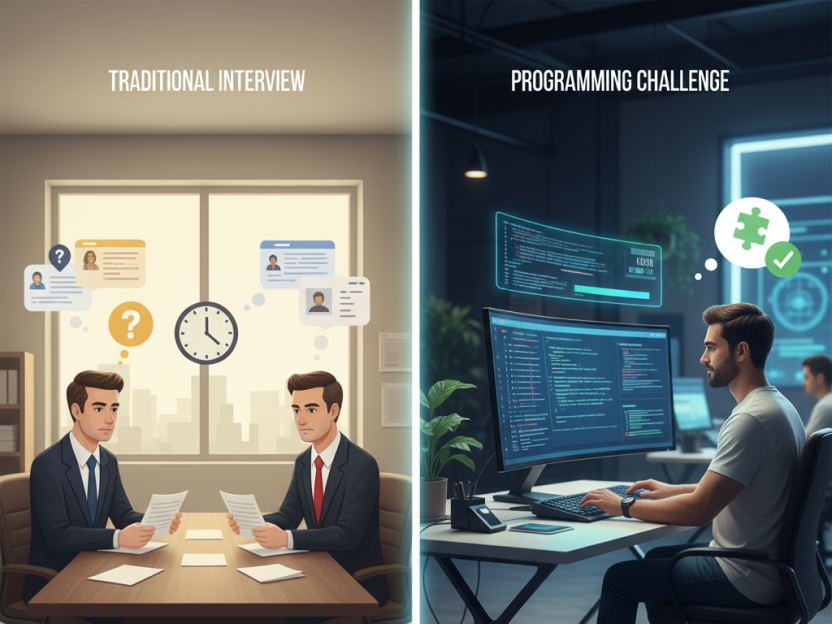
| Criteria | Programming Challenges | Coding Tests | Traditional Interviews |
|---|---|---|---|
| Focus | Real-world problem-solving and logic | Syntax and language-specific skills | Soft skills, communication, and past experience |
| Evaluation | Automated + human review for skill-based accuracy | Pass/fail or correctness-based grading | Subjective human judgment |
| Predictive Power | High for job-fit and analytical strength | Moderate for technical knowledge | Low, often biased and inconsistent |
| Scalability | Very high with automation | Good, depending on test type | Limited due to manual process |
The Core Purpose of Programming Challenges in Hiring:
- Assess Practical Ability: Test technical logic, problem-solving, and debugging skills beyond résumés and theoretical interviews.
- Ensure Objective Evaluation: Provide a fair, measurable, and scalable way to quantify a candidate’s skill level.
- Reduce Hiring Bias: By focusing on code performance and logical outcomes, they minimize subjective human judgment and demographic bias.
2. The Data: Key Trends and the ROI of Skill Assessments (2023–2025)
The shift toward skill-based hiring is not merely a trend—it is a data-driven mandate for better hiring outcomes. Programming challenges are the mechanism driving this change.
Current industry data highlights the transformative impact of these structured assessments:
- Developer Preference: 66% of developers prefer practical, work-sample challenges over abstract, academic tests, leading to higher offer acceptance rates.
- Hiring Speed: Companies report a 40% faster time-to-hire when structured skill assessments are used to quickly filter top candidates.
- Quality of Hire & Retention: Skill-based methods correlate with 22% fewer wrong hires and a 24% better retention rate for new employees.
- Engagement Through Gamification: The gamification market in HR tech is projected to reach $30.7 billion by 2025, emphasizing how engaging challenge design is crucial for candidate experience.
3. Real-World Adoption: Programming Challenge Case Studies
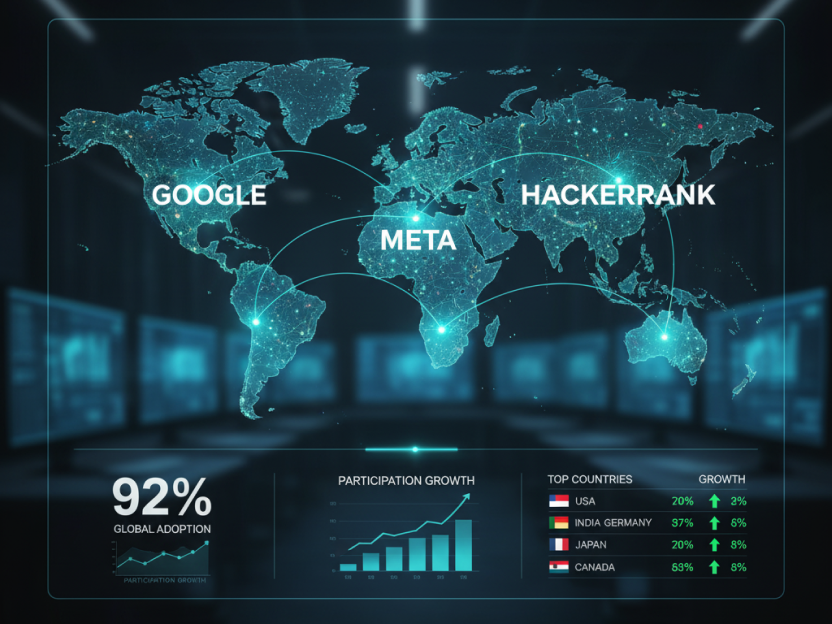
Leading technology firms rely on robust programming challenges to maintain their competitive edge and filter for elite talent
| Company/Platform | Assessment Method Focus | Primary Benefit |
|---|---|---|
| Google (Alphabet) | Live coding sessions and take-home challenges on complex algorithms. | Tests logic, data structures, and the ability to articulate thought processes under pressure. |
| Meta (Facebook) | Collaborative problem-solving sessions using real-world product scenarios. | Reduces individual bias and evaluates how a candidate works and communicates within a team environment. |
| HackerRank & DevSkiller | AI-driven, job-relevant skill assessments and real-time analytics. | Provides objective scoring, scalability, and anti-cheating measures across global hiring pipelines. |
4. Pros and Cons: A Balanced View of Programming Challenges
While highly effective, implementing programming challenges requires careful consideration of both the benefits and potential drawbacks for employers and candidates alike.
| Pros (✅) | Cons (❌) | |
|---|---|---|
| For Employers: |
|
|
| For Candidates: |
|
|
5. The Role of AI, Automation, and Gamification in Refining Assessments
The effectiveness of programming challenges is dramatically improved by integrating next-generation HR technology:
- AI Proctoring & Integrity: AI monitors candidate behavior, ensuring test integrity and fairness by flagging suspicious activity without constant human supervision.
- AI-Powered Integrated Development Environments (IDEs): Challenges are hosted in AI-enabled IDEs that closely replicate the actual tools and environments developers use daily, boosting the test's relevance.
- Gamified Challenges: Adding elements like leaderboards, progress bars, and reward systems increases candidate engagement and can reveal crucial soft skills such as persistence and resourcefulness.
- Automation for Analytics: Automation speeds up score calculation, provides deeper analytics on solution efficiency, and significantly reduces the potential for human scoring bias.
6. Best Practices: Structuring Effective Programming Challenges
To maximize the predictive validity of your assessment, HR teams must adhere to key best practices:
- Align to the Job Stack: The tasks must use the specific languages, frameworks, and libraries that the candidate will use on the job (e.g., Python with Django, or React with TypeScript).
- Use a Hybrid Mix: Combine classic algorithmic problems (to test core logic) with project-based challenges (to test application of knowledge and architecture).
- Hybrid Evaluation Model: Implement a system where AI provides the initial, objective scoring, followed by a brief human code review to assess code quality, commenting, and maintainability.
- Maintain Transparency: Ensure clear, concise instructions and a transparent scoring rubric so candidates understand exactly what is being measured.
- Regularly Refresh Questions: Update the pool of questions frequently to prevent cheating and ensure assessment relevance against the rapidly evolving technology landscape.
7. Future Outlook: The Evolution of Programming Challenges (2026–2030)
Looking ahead, programming challenges will continue to evolve, moving toward greater personalization and real-world simulation:
- Adaptive, Real-Time Challenges: Generative AI will create unique, increasingly complex challenges in real-time, adapting the difficulty curve based on the candidate's performance.
- Collaborative Coding Simulations: Assessments will move beyond individual testing to simulate pair programming or small team challenges, better reflecting modern team dynamics.
- Continuous Upskilling Assessments: Programming challenges will be integrated into internal L&D (Learning and Development) platforms, replacing one-time hiring tests with continuous skill validation.
- Bias-Free, Role-Specific Hiring Dominance: As data validation improves, skill-based assessment using programming challenges will become the undisputed standard for identifying high-performing tech talent globally.
Conclusion: Securing Genuine Talent with Data-Backed Assessments
Programming challenges are not just a convenient screening tool; they are transforming developer recruitment into a sophisticated, skill-first, data-backed, and bias-free process. By effectively integrating AI, automation, and real-world task simulation, they ensure that companies hire based on objective ability. For HR leaders and hiring managers, embracing these challenges is the most reliable way to secure genuine coding talent and future-proof your development teams.