

Practical vs. Theoretical Coding Tests: The 0.63 Predictive Edge in Developer Hiring
Introduction: The Shift from Abstract Theory to Real-World Skill
In today’s hyper-competitive tech hiring landscape, recruiters and engineering leaders are fundamentally rethinking how they assess developers. For too long, the industry relied on abstract algorithms and theoretical tests that measured academic knowledge.
However, a new standard is emerging: practical coding challenges. These hands-on, skill-based assessments offer deeper, more accurate insights into real-world problem-solving, coding efficiency, and collaboration.
The data is clear: 96% of developers believe practical assessments simulate real developer tasks more accurately, and a structured approach yields a predictive validity of 0.63 for job performance—significantly higher than traditional screening methods.
So which approach truly works best—and when should you use each to secure the best talent? Let’s explore the definitive differences.
What Are Practical Coding Challenges?
Practical coding challenges are skills-based coding tests that simulate real-world programming scenarios. Instead of asking abstract, "whiteboard" questions, candidates are asked to execute actual developer work.
These challenges are highly effective because they:
- Mimic the Daily Environment: Candidates build APIs, debug applications, optimize algorithms, or collaborate in pair-programming sessions using familiar tools (e.g., GitHub, IDEs like VSCode).
- Demonstrate True Capability: They allow candidates to demonstrate actual coding, debugging, and, crucially, collaboration skills.
- Provide Predictive Signals: They give employers high-fidelity, predictive signals of on-the-job performance—a key metric for reducing expensive mis-hires.
What Are Theoretical Coding Tests?
Theoretical coding tests measure conceptual knowledge rather than practical application. These assessments typically focus on academic topics like algorithms, complex data structures, or computational complexity through multiple-choice questions (MCQs) or written exams.
While they can be useful for quickly screening massive pools of candidates for basic foundational literacy, they rarely reflect the actual, day-to-day tasks developers face. Their lower real-world relevance makes them a weaker predictor of long-term job success.
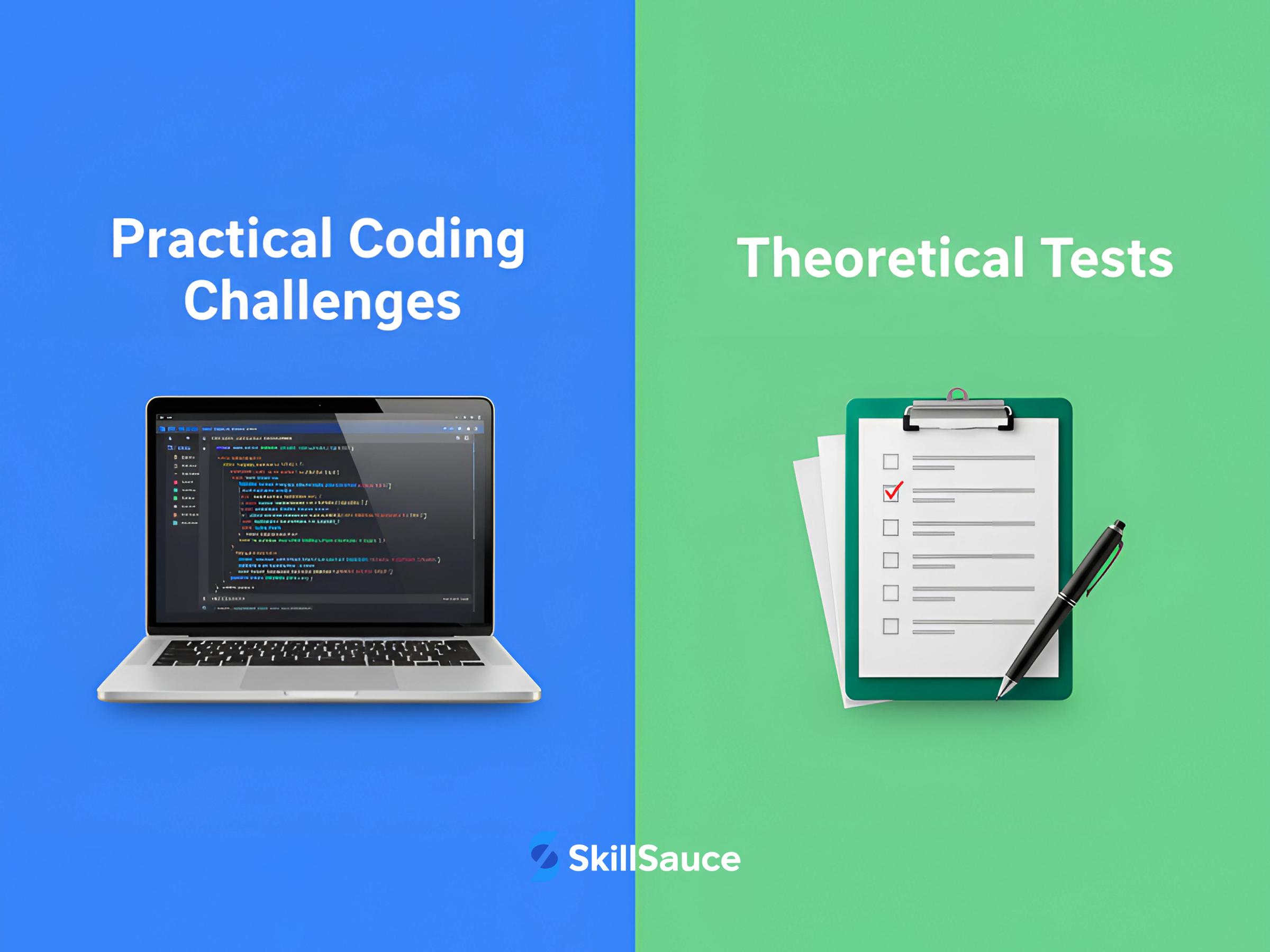
Key Differences: Practical vs. Theoretical Assessments
Data-Backed Case for Skill-Based Assessments (2023–2025)
The shift toward practical testing isn't anecdotal; it's driven by robust hiring data:
- Developer Preference: 66% of developers prefer practical coding challenges over theoretical tests, reporting that the process is fairer and more relevant.
- Interview Anxiety & Bias: 96% believe practical assessments reduce interview anxiety and help reduce bias by focusing solely on output.
- Job Performance Prediction: Structured live coding interviews show a predictive validity of 0.63 for job performance, highlighting their superior power in forecasting success.
- Retention and Cost Savings: Companies using structured coding challenges report 23% lower performance-based termination rates, directly translating to reduced training and replacement costs.
Best Practices: Finding the Right Balance
While practical assessments are superior for deeper evaluation, an efficient hiring process combines both methods strategically:
- Use Short Theoretical Screenings as a Filter: Implement quick, automated theoretical or aptitude tests as a very early filter to handle high-volume applicants for basic algorithmic knowledge.
- Customize the Core Challenge: Implement customized, practical coding challenges that are strictly aligned with the company’s specific tech stack and role requirements.
- Blend Interview Methods: Combine take-home coding tasks (for complexity) with live coding interviews (for collaboration and debugging insights).
- Adopt Automated Scoring with Review: Utilize automated scoring for speed and objectivity, but couple it with a manual, human code review for fairness and depth of evaluation.
The Future Trends in Coding Assessments
Modern hiring platforms recognize that success requires more than just functional code. The next generation of skill-based assessments integrates advanced technology to provide a holistic evaluation:
- AI-Powered Feedback: Adaptive, real-time scoring provides candidates with personalized feedback and assists recruiters in identifying specific skill gaps beyond a simple pass/fail.
- Holistic Skill Evaluation: Platforms are evolving to assess not just coding logic, but also communication, teamwork, and adaptability during collaborative coding sessions.
- Gamification in Recruitment: Interactive challenges with game-like elements are being used to boost candidate engagement and reduce the perceived stress of the assessment process.
- Skill-Based Testing as Standard: By 2030, the industry consensus predicts that practical coding challenges will dominate tech hiring, completely replacing the outdated theoretical test as the primary decision-maker.
Conclusion
When it comes to developer hiring, theoretical tests can serve a limited purpose as a quick filter, but practical coding challenges consistently deliver the best hiring outcomes.
They don't just ask what a candidate knows; they show what a candidate can do. By prioritizing real-world skills through proven, practical assessments, employers can make data-driven, fair, and highly predictive hiring decisions. The future of recruitment is clear: real-world skills matter more than theoretical knowledge.