


Hybrid Work Policy Guide: What Actually Works in 2025
Creating an effective hybrid work policy has become essential for organizations as 71% of US employers now operate hybrid workplaces. While temporary solutions emerged during the pandemic, developing sustainable frameworks for the future requires strategic planning and clear guidelines. As we look at hybrid work trends for 2025, the data speaks volumes about employee preferences. Notably, 45% of job seekers now prioritize remote or hybrid opportunities over traditional in-office roles, with different expectations across experience levels. Senior-level professionals (5+ years) are most likely to work in hybrid arrangements (31%) compared to mid-level (25%) and entry-level positions (18%). Furthermore, organizations offering flexible work arrangements report a 29% lower turnover rate compared to those with rigid in-office policies. Throughout this guide, you'll discover the key components of successful hybrid work policy templates, practical hybrid work policy examples from leading companies, and strategies for implementing hybrid work schedule policies that balance business needs with employee preferences. Additionally, you'll learn how the right hybrid remote work policy sample can be adapted to fit your organization's unique culture and requirements.
Hybrid Work Trends in 2025
The pandemic-era experiment with remote work has evolved into a permanent feature of the modern workplace. By early 2025, remote and hybrid work have become the backbone of how many workers get things done, settling into a long-run equilibrium rather than collapsing or expanding further. This shift represents a fundamental change in how businesses operate, with hybrid models becoming the default template rather than a temporary accommodation.
Shift from temporary to permanent hybrid models
In 2025, hybrid work has cemented its position as a foundational component of modern workforce strategies. Significantly, 73% of workers report their companies haven't changed their remote or hybrid policies in the past year, indicating stability in these arrangements. The permanence of this shift is evident as organizations move beyond viewing hybrid work as an experiment—75% of leaders expect their companies to change their work models in the next two years to better accommodate this reality. Consequently, 95% have already made their workspaces more flexible, with 82% planning to make them even more adaptable.
Adoption rates across industries
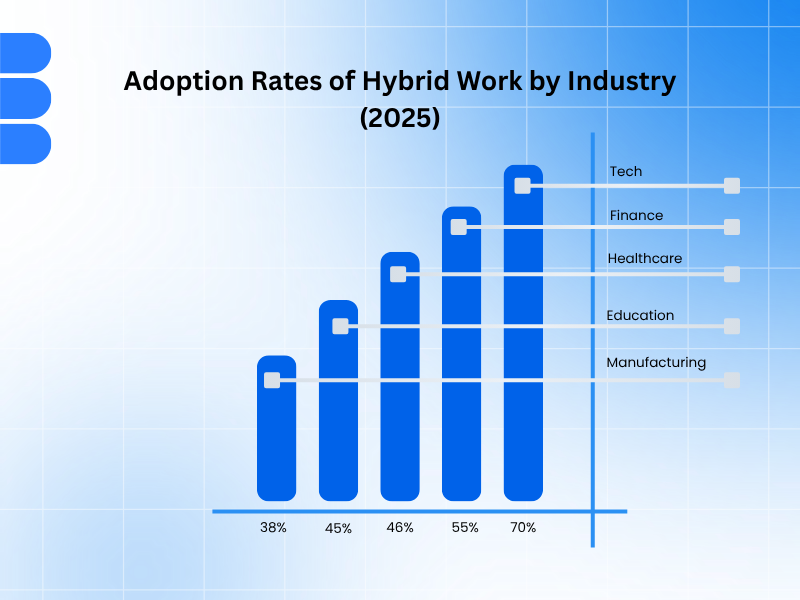
The embrace of hybrid work varies considerably across different sectors: •Technology companies lead in flexibility, with many remaining fully remote. •Financial services maintain stricter in-person requirements, with major banks often requiring 4-5 days in office. •Healthcare and education have the highest full-time office requirements (46% and 45% respectively). •Manufacturing and healthcare are innovating to support partial remote work for administrative roles.
Overall, 64% of business leaders report that their companies now use hybrid models. Interestingly, companies in North America and Europe lead in adoption, but Latin America and parts of Asia are seeing rapid growth as digital infrastructure expands
Employee demand for flexibility
The data clearly shows overwhelming employee preference for flexible arrangements. A striking 83% of global employees prefer a hybrid environment that offers a mix of in-office and remote days. The value placed on this flexibility is evident—if it were taken away, 40% of workers would start job hunting, 22% would expect compensation increases, and 5% would immediately quit. This demand crosses generational lines, though with different intensities. According to Randstad's Workmonitor 2025, 83% of employees now rank work-life balance ahead of pay (82%). This explains why LinkedIn data shows that while remote or hybrid roles make up just 20% of job postings, they attract 60% of applications. Organizations offering flexibility thus gain a significant competitive advantage in talent acquisition and retention.
Key Elements of a Successful Hybrid Work Policy
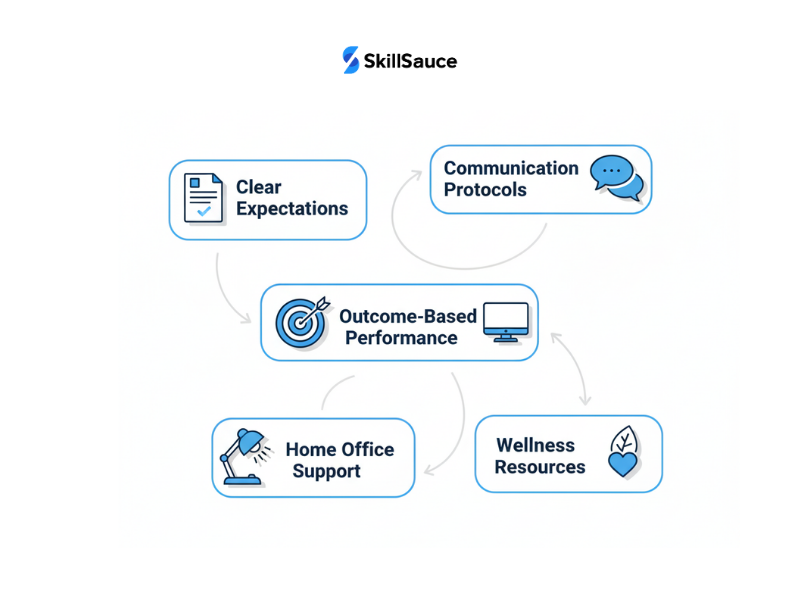
Successful hybrid work policies don't happen by accident. Indeed, nearly half of employees report not understanding their organization's hybrid guidelines, making clear structure essential. A thoughtfully crafted policy addresses five critical areas that determine whether your hybrid approach thrives or fails.
Clear expectations for in-office vs remote days
First, document specific expectations about when and where employees should work. Establish core hours, ensuring team overlap while accommodating individual schedules. Explicitly outline which situations require office presence, such as team meetings or client presentations. When rules are documented in the handbook and implemented consistently, employees gain clarity about responsibilities regardless of location.
Defined communication protocols
Effective communication becomes crucial in hybrid environments where employees split time between locations. Specify preferred channels for different types of communication and set response time expectations. Consider establishing: •Asynchronous tools for flexible scheduling •Regular check-ins for remote team members •Guidelines for inclusive meetings that don't favour in-office workers.
Performance measurement based on outcomes
Hybrid success requires shifting from monitoring activities or hours worked to evaluating results produced. Focus on accomplishments and outcomes rather than physical presence. Only 22% of organizations establish metrics to quantify productivity improvements from hybrid work, despite 54% reporting improved productivity. Leaders should regularly assess performance using weekly evaluations and objective measurements where possible.
Support for home office setup
Remote workers often lack proper ergonomic setups, leading to discomfort or injuries. Consider providing stipends for essential equipment like adjustable chairs, laptop risers, and external keyboards. Most importantly, establish guidelines for healthy home workspaces, including proper lighting, posture requirements, and dedicated work areas.
Inclusion of mental health and wellness resources
Hybrid work presents unique mental health challenges including digital fatigue, blurred boundaries, and isolation. Essential wellness resources should include Employee Assistance Programs, virtual therapy options, and mental health training for managers. Make these programs accessible to all employees regardless of location. Leaders should also model healthy behaviors by checking in regularly with team members about wellbeing, not just tasks.
Technology and Tools That Enable Hybrid Work
The backbone of any effective hybrid work policy lies in technology that bridges physical and virtual workspaces. Implementing the right tools ensures seamless operation regardless of employee location.
Collaboration platforms and cloud tools
Cloud-based collaboration platforms have become essential for hybrid teams. Tools like Microsoft Teams, Slack, and Google Workspace enable real-time document collaboration, secure file sharing, and integrated communication. These platforms function as digital headquarters, replacing cluttered email inboxes with organized, channel-based conversations. Moreover, unified communications systems consolidate voice, video, messaging, and collaboration into single platforms, enhancing workflow efficiency as teams switch between different communication modes.
Security and access management
For hybrid models, security remains paramount. Multi-factor authentication protects against compromised credentials, with Microsoft reporting that adding a second factor blocks almost 99% of automated takeover attempts. Increasingly, organizations adopt Zero Trust security frameworks operating on the principle of "never trust, always verify". This approach, combined with secure access management solutions, ensures employees can access resources safely regardless of location.
Productivity tracking and analytics
Workplace analytics provide valuable insights into how employees utilize spaces and resources. Organizations employing these tools report 73% of managers feel more empowered to execute their hybrid strategies. These platforms track patterns in desk bookings, meeting room usage, and collaboration activities, allowing leaders to make data-driven decisions about office layouts and resource allocation.
Virtual onboarding and training systems
Remote onboarding programs now replace traditional orientation with structured digital experiences. Learning management systems (LMS) deliver consistent training while tracking progress. Companies using AI-driven platforms report 20% higher training productivity through personalized skill paths tailored to diverse schedules. Screen recording tools like Loom simplify creating and sharing video-based training content, allowing employees to learn at their own pace.
Examples and Templates for Hybrid Work Policies
Turning hybrid work concepts into actionable policies requires clear templates and real-world examples. A well-crafted policy saves time and ensures consistency across your organization.
Hybrid work policy template overview
An effective hybrid work policy template typically includes several fundamental components: scope, eligibility criteria, scheduling parameters, workspace requirements, and communication protocols. Essentially, these templates establish who can work remotely, when they should be in-office, and how teams will collaborate. Most templates require employees to complete an introductory period (typically 3 months) before eligibility, maintain satisfactory performance, and follow structured application processes.
Hybrid remote work policy sample for tech teams
Tech-focused policies often emphasize flexibility and results. In particular, such policies might include: •Core collaboration hours (10 AM-3 PM Tuesday-Thursday) •No-meeting days (commonly Fridays) •Remote-first communication guidelines Many tech companies permit up to 50% remote work with manager approval, prioritizing outcome measurement over physical presence.
Hybrid work schedule policy for customer-facing roles
Customer-facing roles typically require more structured hybrid arrangements. For these positions, policies often specify: •Office presence during peak customer interaction times •Split-week schedules (usually 3 days in-office, 2 days remote) •Designated collaboration days when all team members are present
Hybrid work policy examples from leading companies
Leading organizations have developed distinctive approaches: Airbnb allows monthly in-office visits rather than weekly requirements, meanwhile Citigroup maintains a three-days-in-office structure that has become a talent attraction strategy. HubSpot offers three work styles (@home, @flex, @office) with 72% of employees selecting fully remote arrangements.
Conclusion
Hybrid work has clearly evolved from a pandemic necessity to a permanent workplace feature. Companies that develop thoughtful, well-structured policies gain significant advantages in talent acquisition and retention. After all, the data speaks volumes – organizations offering flexibility report 29% lower turnover rates while hybrid job postings attract three times more applications than traditional roles. Success with hybrid work depends primarily on establishing clarity. Your policy must address when employees should work on-site versus remotely, how teams will communicate effectively across locations, and what metrics will measure performance. Additionally, providing proper home office support and wellness resources ensures sustainability. The right technology serves as the foundation for these arrangements. Cloud collaboration tools, robust security frameworks, analytics platforms, and virtual training systems bridge physical divides. Without these tools, even the most well-designed policy would struggle to function effectively. The most successful organizations recognize that hybrid work looks different across teams and industries. Tech companies might thrive with minimal office requirements, while customer-facing roles often benefit from structured hybrid schedules with designated collaboration days. Furthermore, companies like Airbnb, Citigroup, and HubSpot demonstrate how distinctive approaches can align with organizational values while meeting employee expectations. As hybrid work continues to shape workplace dynamics through 2025 and beyond, your organization faces a critical choice. You can either embrace this shift with strategic policies that balance business needs and employee preferences, or risk losing top talent to competitors who do. The companies that thrive will be those that view hybrid work not as a compromise but as an opportunity to build more flexible, productive, and employee-centred workplace.