


Introduction
The job hunt has been transformed by artificial intelligence. No longer just a vision of the future, AI is now at the core of many recruitment processes, screening resumes, running interviews, and even deciding who gets a shot at opportunity. But as AI's influence grows, so do questions from lawmakers, activists, and everyday applicants about bias, fairness, and how job seekers can succeed in a machine-driven age.
Today, approximately 67% of organizations use AI in recruitment, with enterprise companies leading adoption at 78%—a 189% increase since 2022. Yet this rapid expansion has also sparked regulatory scrutiny. The EU Artificial Intelligence Act (effective August 2, 2026) classifies recruitment AI as high-risk and requires rigorous compliance measures. In the United States, the EEOC has made clear that Title VII Civil Rights Act protections apply fully to algorithmic hiring systems.
This guide explores how AI reshapes hiring, the opportunities and risks it presents, and practical strategies for both job seekers and employers navigating this transformation.
AI in the Hiring Process: How It Works
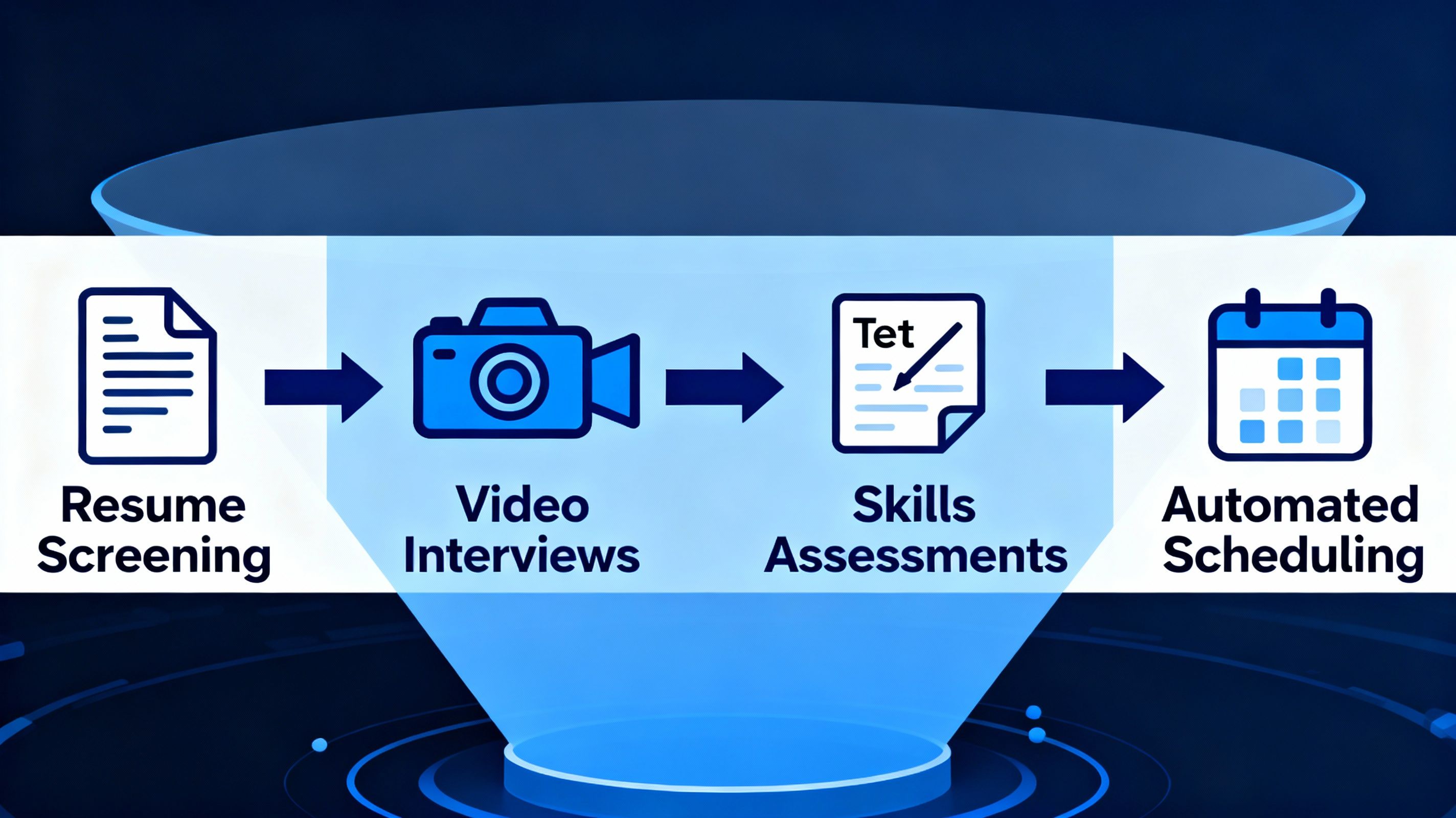
AI automates and optimizes many steps of the recruitment funnel, from initial screening to final candidate ranking:
Resume Screening
Software parses thousands of applications in seconds, extracting keywords, experience levels, qualifications, and pattern matches against employer criteria. Modern AI systems can identify relevant skills even when phrased differently across resumes, reducing initial review time by 60–70%.
Video and Voice Interview Analysis
Platforms like those offered by SkillSauce's AI interview technology analyze candidate responses using natural language processing (NLP), evaluating communication clarity, strategic thinking depth, and competency demonstration. Some systems also assess tone, pacing, and delivery consistency.
Behavioral and Skills Assessments
AI grades pre-employment tests, online problem-solving tasks, or gamified challenges to rank applicants objectively. These adaptive assessments adjust difficulty based on responses, ensuring fair evaluation across diverse backgrounds. SkillSauce's assessment library provides customizable behavioral and cognitive tests designed for product managers and other specialized roles.
Automated Scheduling and Communication
Chatbots schedule interviews, answer frequently asked candidate questions, and provide real-time updates throughout the recruitment process. This reduces manual scheduling overhead by 45–60% and improves candidate experience.
Predictive Analytics
Advanced systems predict job performance, retention, and culture fit based on assessment data. Research shows AI can forecast on-the-job success with 78% accuracy and 12-month retention with 83% accuracy.
These algorithms promise efficiency and consistency. But are they always fair?
The Benefits of AI Recruitment
Speed: From Weeks to Days
AI can process thousands of applications simultaneously, reducing time-to-hire from 45–60 days to 22–25 days—a 50% reduction. This speed advantage is critical in competitive talent markets where top candidates receive multiple offers within days.
Scalability: No Candidate Left Behind
Companies can process large applicant pools comprehensively. Human recruiters face cognitive overload after reviewing 100–150 resumes; AI handles 10,000+ without fatigue, ensuring qualified candidates aren't missed due to review bottlenecks.
Cost Efficiency: 30–40% Savings
AI reduces recruiter hours dedicated to initial screening, scheduling, and communication. Organizations report cost-per-hire reductions of $8,000–10,000 per role, with larger ROI when scaling across multiple hiring needs.
Some Bias Reduction: When Done Right
Well-designed systems apply identical criteria to every applicant, standardizing evaluation and potentially reducing some types of human bias. Studies show structured AI-assisted interviews reduce bias by 50% compared to unstructured human interviews. When combined with anonymization (removing names, photos, graduation dates), AI can improve diversity by 25%.
Data-Driven Decisions
AI converts qualitative impressions into quantifiable hiring signals. Instead of "I liked them," hiring managers see: "Strategic reasoning score: 78/100; communication clarity: 72/100; analytical ability: 85/100. Predicted performance: strong."
The Dark Side: Algorithmic Bias and the Pushback
Despite benefits, AI-driven hiring carries significant risks if not properly designed and monitored.
Computerized Bias: Garbage In, Garbage Out
If an AI system is trained on biased historical data, it perpetuates or amplifies unfairness. Classic example: Amazon's recruiting AI learned to penalize women's resumes after being trained on decades of male-dominated tech hiring patterns. Gender, ethnicity, age, and other protected traits can be systematically disadvantaged by flawed algorithms, even unintentionally.
Lack of Transparency: The Black Box Problem
Many candidates and even hiring managers don't understand how AI decisions were made. A candidate rejected by algorithmic screening might never know their resume was flagged for a vague pattern or association—not their qualifications. This lack of explainability undermines trust and makes it difficult to appeal or correct errors.
Denial of Opportunity: Trapped by Algorithm
Qualified candidates may be filtered out for reasons they cannot see, understand, or correct. If a video interview AI misinterprets a candidate's speech pattern, accent, or cultural communication style, that person never gets a chance to prove capability in person.
Data Privacy Concerns
AI hiring systems collect and store sensitive personal data—video recordings, psychological profiles, even biometric data (eye gaze, facial expressions) in some advanced systems. Misuse or breach exposes candidates to privacy violations.
Regulatory Backlash: The Compliance Era
This backlash has led lawmakers and regulators to mandate greater transparency and accountability:
EU Artificial Intelligence Act (Effective Aug 2, 2026): Recruitment AI classified as high-risk; requires rigorous bias testing, documentation, human oversight, continuous monitoring, and transparency to candidates. Violation penalties: €35 million or 7% of global revenue.
EEOC Guidance: Title VII Civil Rights Act applies fully to AI hiring decisions. Employers are liable for discriminatory outcomes, regardless of intent.
NYC Local Law 144 (Active): Requires annual independent bias audits of AI hiring tools. Penalties: $1,500 per violation.
Colorado SB 24-205 (Effective Feb 1, 2026): Mandates bias audits for high-risk AI in employment. Employers must demonstrate reasonable care to prevent algorithmic discrimination.
How Candidates Can Outsmart the AI
Optimize Your Resume: Keywords Matter
Customize your resume for each job using keywords directly from the job posting. AI resume screening systems look for specific skill mentions, certifications, and role-relevant terminology. However, avoid keyword stuffing; maintain authenticity and clarity.
Example: If the job posting emphasizes "cross-functional collaboration" and "data-driven decision making," ensure these concepts appear in your experience descriptions, not just your bullet points.
Be Authentic—but Ready for Automation
Practice automated video interviews before your real submission. Test your setup: lighting (face evenly illuminated), sound quality (clear audio, minimal background noise), and background (professional but personable). Speak clearly, pause thoughtfully, and frame answers with specific examples using the STAR method (Situation, Task, Action, Result).
Pro tip: Record yourself answering sample questions; review for clarity, pacing, and confidence. Platforms like SkillSauce's AI Interview system often provide immediate feedback to help candidates improve.
Highlight Both Hard and Soft Skills
AI systems look for technical capabilities (coding languages, data analysis tools, product methodologies) AND soft skills (communication, leadership, adaptability, cross-functional collaboration). Quantify impact where possible: "Led cross-functional team to ship feature 40% faster than planned through improved stakeholder alignment."
Research the Employer's Platform
If available, learn what hiring technologies a company uses. Some publicize their tools; others require research. Understanding whether a company uses SkillSauce's assessment library, HireVue video interviews, or other platforms helps you prepare appropriately.
Understand Protected Rights
Under emerging regulations, especially the EU AI Act and EEOC guidance, candidates have rights:
- Right to explanation: Request clarity on why you were rejected
- Right to appeal: Challenge algorithmic decisions if bias is suspected
- Right to data access: Know what data was collected and how it was used
- Right to human review: Request that a human make or review final decisions
Familiarize yourself with these rights in your jurisdiction.
Best Practices for Employers Implementing AI in Hiring
Regular Bias Audits: The Non-Negotiable Requirement
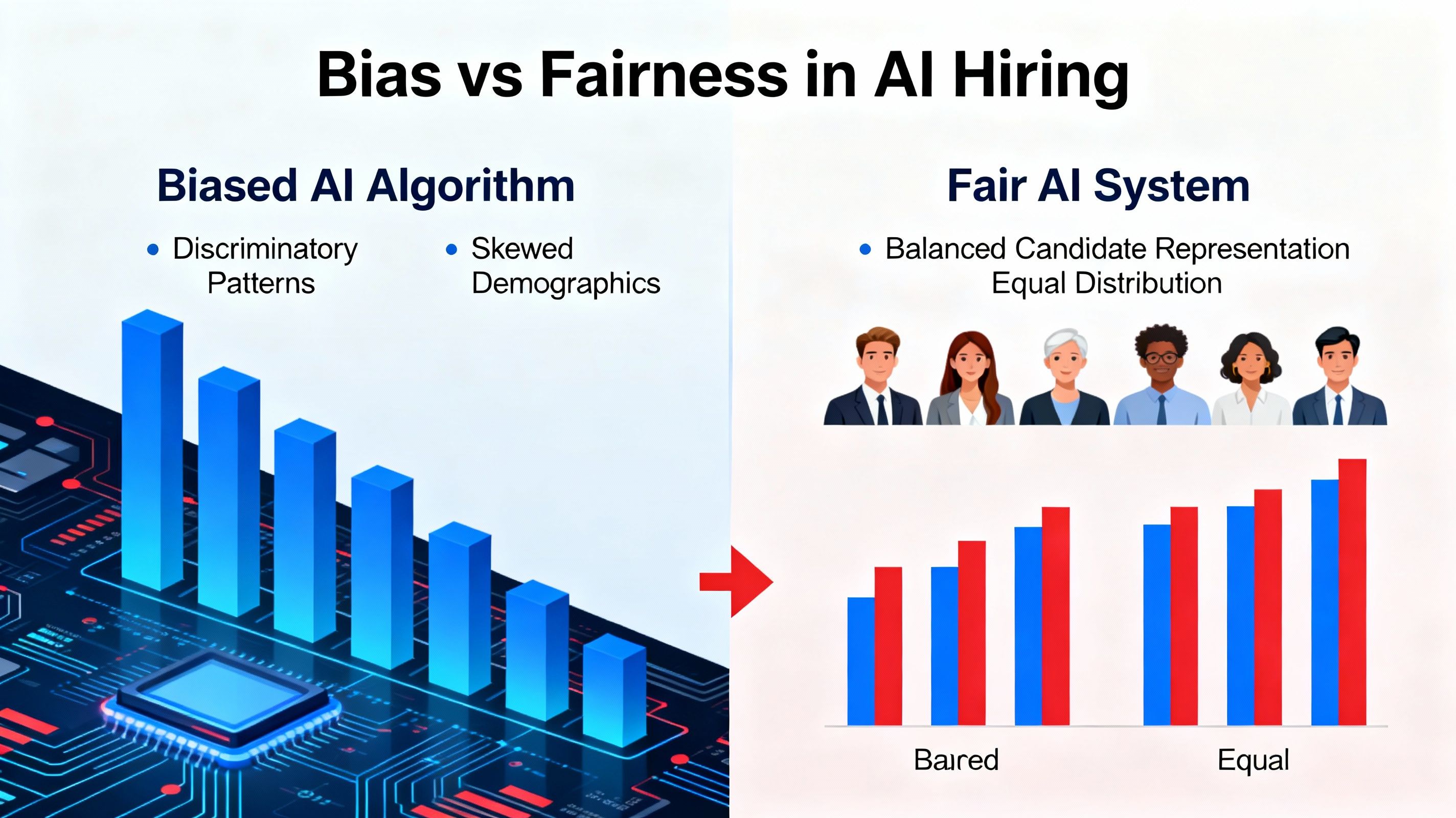
Conduct quarterly fairness reviews comparing outcomes across gender, race, age, and other demographic groups. If disparate impact is detected (e.g., 1.25x difference between groups), investigate root causes and remediate immediately.
Action: Partner with independent auditors (regulatory requirement in many jurisdictions by 2026); maintain detailed audit documentation for compliance and legal defensibility.
Transparency and Communication: Build Trust
Inform candidates upfront when AI is used in hiring. Explain which stages involve algorithms and why. Provide clear communication when candidates are rejected:
"Your application didn't advance past initial screening because your background didn't match our specific technology stack requirements (Python, React, AWS). We encourage you to apply for future roles."
This transparency reduces candidate frustration and builds employer brand trust.
Keep the Human Touch: AI Informs, Humans Decide
Use AI as a first pass to filter high-volume applications, but always have skilled recruiters and hiring managers review shortlisted candidates and make final decisions. AI identifies patterns; humans apply judgment, assess cultural fit nuance, and evaluate growth potential.
Best practice: Reserve final hiring decisions for humans; use SkillSauce's assessment library and AI interview platform to provide structured data informing—but not replacing—human judgment.
Protect Candidate Data: Privacy by Design
Use and store recruitment data responsibly, under GDPR, CCPA, and other privacy regulations:
- Collect only data necessary for hiring decisions
- Store data securely with access controls
- Delete candidate data after hiring decision (typically 12 months post-decision)
- Use data exclusively for recruitment, not other purposes (e.g., marketing, credit scoring)
Compliance note: Under EU AI Act, organizations must document data provenance, quality, and bias mitigation measures.
Train Your Team: AI Literacy
Recruiters and hiring managers must understand how AI tools work, their limitations, and potential biases. Invest in training to demystify algorithms and reinforce that AI provides insights—not verdicts.
Resource: SkillSauce provides training resources and best-practice guides to help teams use assessment tools responsibly.
Integrate Fairness Monitoring
Use platforms like SkillSauce that include bias mitigation dashboards, automatically flagging disparate impact and enabling continuous monitoring.
Case Study: Responsible AI Adoption in Practice
Unilever's Global Recruitment Transformation (2019–2024)
Challenge: 190+ countries, 14,000+ annual applications; traditional phone screens created bottlenecks.
Solution: Partnership with Pymetrics (neuroscience-based games) and video interviews; rigorous bias testing and fairness monitoring.
Results:
- Time-to-hire: 45 days → 7 days (84% reduction)
- Cost savings: 70% reduction in cost-per-hire
- Diversity: Expanded candidate pool; removed unconscious bias from resume screening
- Compliance: Proactive bias audits; transparency to candidates
Key lesson: Speed and fairness aren't trade-offs; well-designed AI delivers both.
The Future of AI in Recruitment
AI's role in hiring will continue evolving with advances in natural language understanding, video analytics, and predictive modeling. However, the debate around fairness, inclusion, and ethical decision-making will intensify—not diminish.
Emerging Trends (2025–2027)
Skill-Based Hiring: By 2027, 44% of workers' core skills will shift due to AI and automation. Employers will increasingly hire based on demonstrated skills rather than credentials or pedigree, expanding talent pools 6.1x and reducing hiring bias.
Predictive Analytics: AI will forecast organizational talent needs 18 months in advance, enabling proactive sourcing and reducing unexpected vacancies.
Agentic AI: Autonomous AI agents will manage recruitment end-to-end—sourcing, outreach, screening, scheduling—with human oversight for final decisions. Expected mainstream adoption by 2027–2028.
Regulatory Convergence: More jurisdictions will adopt EU AI Act–style regulations. Compliance will become table stakes, not competitive advantage.
Winning Strategy: Human + AI Collaboration
Job seekers and companies willing to understand, adapt to, and ethically implement AI-driven hiring will thrive in the digital hiring landscape. The winners won't be those who eliminate human judgment or automate blindly; they'll be those who leverage AI's efficiency while preserving the human judgment, empathy, and strategic thinking that drive great hiring decisions.
Get Started with Fair, Efficient AI Hiring
Organizations ready to transform recruitment while maintaining ethical standards should:
- Audit your current process for bias and inefficiency; establish baseline metrics
- Implement structured assessments using platforms like SkillSauce's AI Interview and Assessment Library
- Monitor fairness continuously using bias dashboards; track outcomes by demographic group
- Train your team on AI literacy, responsible tool usage, and compliance obligations
- Communicate transparently with candidates; build trust through openness
Ready to implement AI-driven, fair hiring? Schedule a demo of SkillSauce.io's AI Interview Platform, Assessment Library, and Compliance Features. Discover how organizations like Unilever reduced time-to-hire by 84% while improving quality and diversity. [Schedule Demo]