

AI Interviews: How They Work, Save Time, and Why Recruiters Should Adopt Them
AI interviews are rapidly reshaping the recruitment landscape, introducing unparalleled levels of automation, objectivity, and speed into the critical process of candidate evaluation. As the demand for efficiency and fairness in hiring intensifies, intelligent interview systems are moving from novel tools to essential infrastructure. With industry forecasts, such as Staffing.iQuasar (2025), expecting 68% of companies to integrate AI into their selection process by 2025, recruiters who embrace this technology will gain a definitive competitive edge. This guide dives deep into the mechanism, benefits, and ethical considerations of AI-driven interviewing.
1. The Historical Shift: From Manual Screening to Intelligent Automation
For decades, the interview process—the cornerstone of talent acquisition—has been plagued by inherent inefficiencies. Traditional interviews suffer from:
- Scheduling Delays: The tedious back-and-forth of coordinating multiple interviewers and candidates.
- Subjective Judgments: Human biases, conscious and unconscious, that compromise the impartiality of evaluations.
- Limited Scalability: The inability of human recruiters to screen hundreds or thousands of applicants efficiently for large-scale roles.
The initial answer to these challenges was the video interview, which digitized the conversation but didn't eliminate human bias or scheduling bottlenecks. AI interviews represent the next evolution, moving beyond simple recording to enabling asynchronous, data-driven conversations. These intelligent systems allow organizations to efficiently screen vast pools of candidates, dramatically reducing the burden on human resources staff.
According to research from Hirebee AI (2025), organizations that effectively deploy AI interviews report a 30–50% faster time-to-hire and significant reductions in bias compared to manual interviews. The technology has evolved to become highly sophisticated, capable of analyzing subtle non-verbal cues, linguistic patterns, and behavioral indicators far more consistently than a human interviewer.
2. Defining the AI Interview: Mechanism and Types
An AI interview utilises artificial intelligence and machine learning to evaluate candidate responses across various modalities, including text, video, and voice interactions. These interviews can be deployed in two primary formats:
- Fully Automated: The AI conducts the entire structured interview autonomously, providing the candidate with questions and analyzing the responses in real-time.
- Hybrid: The AI assists human recruiters by analyzing a recorded human interview, offering supplementary analytics, objective scoring, and red-flag identification.
Key Types of AI Interviews
The Core Technology Foundation
The power of the AI interview rests on the convergence of several machine learning disciplines:
- Natural Language Processing (NLP): This is the engine that interprets spoken or written words to determine semantic clarity, contextual meaning, and complex concepts.
- Speech Recognition (ASR): Converts voice to accurate text transcripts, providing a consistent textual foundation for further analysis, regardless of background noise or accent.
- Sentiment and Facial Analysis: These systems leverage computer vision and deep learning to detect key emotional indicators, levels of engagement, and genuine confidence, helping to gauge soft skills.
- Behavioral Pattern Detection: Sophisticated models evaluate delivery, speaking pace, gaze direction, and body language consistency against large datasets of successful hires.
- Multimodal Integration: The most advanced AI interview systems combine these inputs (video, text, and voice signals) into a single, holistic scoring model, providing a comprehensive candidate profile.
As HireVue (2024) affirms: “AI interviews don’t replace human decision-making — they amplify consistency by eliminating variability in how candidates are rated.”
3. How AI Interviews Work
The process of an AI interview is a systematic, data-driven workflow that transforms unstructured human communication into measurable, objective insights:
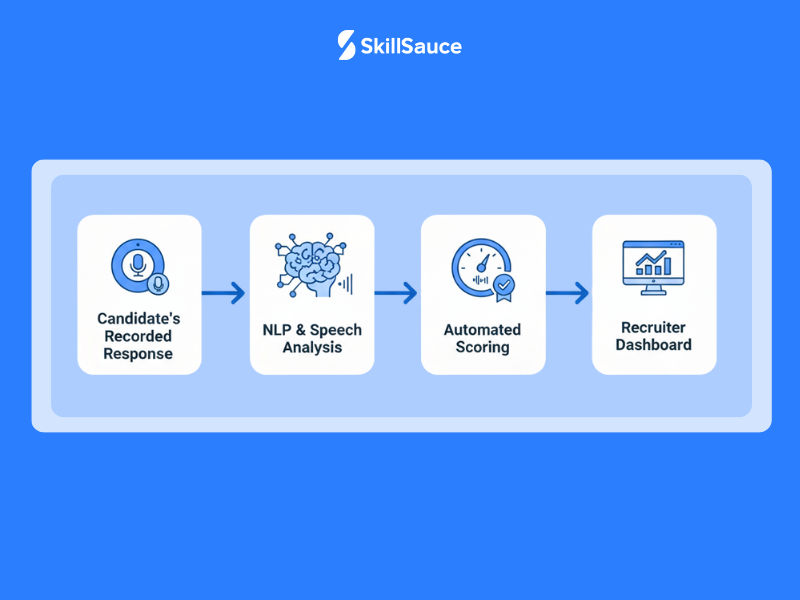
- Data Capture: The candidate's responses (video, audio, or text) are recorded in a standardized environment, often asynchronously.
- Speech-to-Text Conversion: For audio and video responses, the content is transcribed into text using advanced ASR models, preparing it for linguistic processing.
- NLP & Sentiment Analysis: Algorithms examine the textual content for clarity, depth, and the emotional tone conveyed, mapping the response against desired competencies.
- Facial & Behavioral Recognition: Computer vision identifies key behavioral traits, such as eye contact, enthusiasm, and speaking pace, providing indicators of communication confidence and focus.
- Machine Learning Scoring: The integrated system compares the candidate's holistic data profile to pre-trained benchmarks derived from high-performing employees. The ML model assigns objective scores for specific skills, such as empathy, critical thinking, and communication effectiveness.
- Automated Reports: The final output is a bias-free competency summary and candidate ranking, providing the human recruiter with actionable, structured data.
According to research cited by the IEEE Computer Society (2025), AI-driven analysis of these multimodal inputs detects verbal and tonal nuances 45% more accurately than reliance on manual transcripts or human memory alone, making evaluations demonstrably more reliable.
4. Operational Benefits: Time Savings and Efficiency Gains
The primary appeal of AI interviews is the dramatic shortening of the hiring cycle, which directly impacts the bottom line. By automating the most time-consuming elements—scheduling, recording, and initial scoring—HR teams achieve unprecedented scalability, allowing them to manage hundreds of candidates simultaneously.
Key Benefits of AI Interviews for Recruiters
Direct Recruiter Benefits:
- Mass Parallel Interviewing: Recruiters can initiate interviews for large applicant pools simultaneously, rather than sequentially.
- Instant, Structured Scoring: Immediate analytical reports replace hours spent reviewing notes and manually scoring candidates.
- Seamless ATS Integration: Most leading AI interview platforms offer seamless integration with existing Applicant Tracking Systems (ATS), automating data flow and predictive dashboards.
SkillSauce.io’s AI interview modules are designed specifically to automate early-stage screenings, provide objective scoring, and standardize evaluations across geographically dispersed teams. This allows recruiters to hire faster without sacrificing the essential element of fairness.
5. AI Interviews in Skills-Based Hiring Ecosystems
The modern labor market demands a move toward a skills-first hiring model, prioritizing measurable competencies over traditional proxies like university attended or prior job titles. In this new ecosystem, AI interviews are a pivotal tool.
They act as a crucial link that complements technical skill assessments (like coding tests), psychometric evaluations, and behavioral assessments to create a 360° candidate profile. This holistic view shifts the focus from "who you know" or "where you've been" to "what you can do."
Platforms like SkillSauce.io integrate AI interview data directly with rigorous skill assessment results. This combined data allows companies to identify top talent based on objectively measurable skills and behavioral indicators, effectively promoting diversity and merit-based hiring outcomes.
6. Addressing Ethical Concerns: Bias, Transparency, and Fairness
Concerns regarding algorithmic bias are critical and must be addressed with proactive governance. While AI models can perpetuate biases present in their training data, ongoing research and ethical standards are leading to significant improvements:
- Bias Audits (IJMSRT Journal, 2025): Studies consistently show that inclusivity improves when ML models are trained on large, diverse, and meticulously balanced datasets that reflect equitable hiring practices.
- Fairness in AI Recruitment (arXiv, 2024): The focus is increasingly on explainable and mandatory human oversight, ensuring recruiters understand why a score was assigned and can override or investigate suspect results.
- Compliance: Ethical AI interview design is now a mandatory requirement under emerging regulations like the European Union’s Artificial Intelligence Act and similar Algorithmic Accountability Acts in the US.
Recruiter Best Practices for Ethical Deployment:
- Vendor Vetting: Only select vendors who commit to independent fairness audits and transparent data collection practices.
- Human Validation: Never rely solely on an AI score. Always combine AI scoring with human validation during the final rounds of the selection process.
- Transparency with Candidates: Be open and upfront with applicants about how their data is used and what specific, objective evaluation criteria the AI is applying.
7. Future Trends in AI-Driven Recruitment (2026 and Beyond)
The field of AI interviews is evolving rapidly, with several disruptive trends on the horizon:
- Adaptive AI Interviews: Future systems will go beyond static questioning. They will adjust the difficulty, contextual relevance, and even the "tone" of the questions dynamically based on the candidate's previous responses, making the interview experience more personalized and challenging.
- Agentic AI: Highly autonomous, agentic virtual recruiter agents will be capable of autonomously conducting, scoring, and summarizing entire interview cycles, only escalating a pre-qualified candidate to a human manager.
- Bias-Safe Auditing: Real-time correction algorithms and continuous bias-logging features will become standard, providing an auditable trail for every hiring decision and flagging potential issues before they impact outcomes.
- Predictive Integration: AI interview data will be seamlessly fed into sophisticated long-term performance and retention models, allowing organizations to link specific interview behaviors to future employee success with unparalleled precision.
Conclusion
The AI interview is not merely a transient HR trend—it is the foundation of a modern, data-driven talent acquisition strategy. It delivers a faster, fairer, and dramatically more consistent recruitment process. By integrating sophisticated AI-driven evaluations with unified skills platforms like SkillSauce.io, recruiters are empowered to move past administrative logistics and focus entirely on talent potential—achieving speed, scalability, and fairness in every single hiring decision. Embracing this shift is the key to thriving in the competitive talent market of tomorrow.